
Camera On or Camera Off? The Real Leadership Question Is: Why

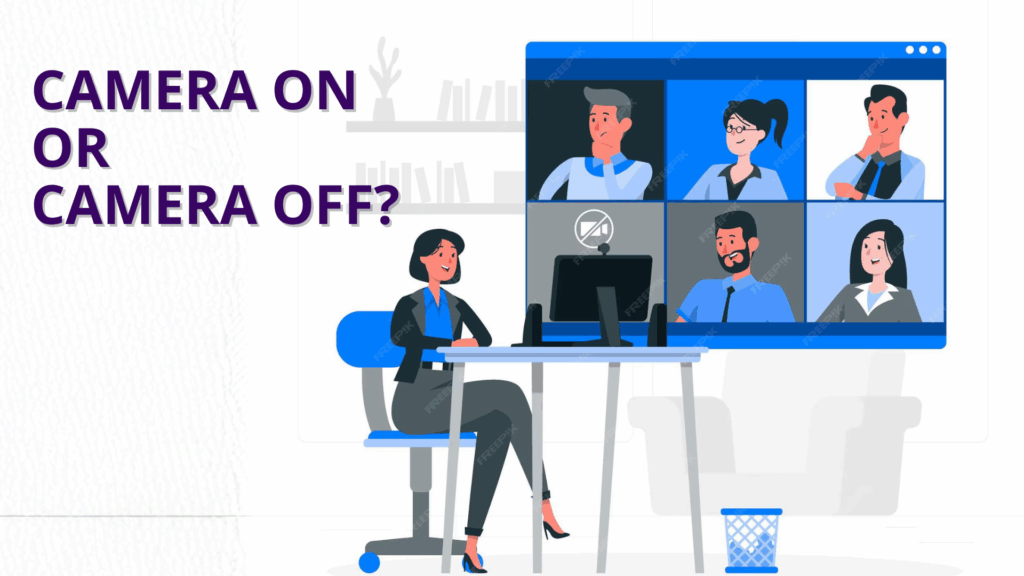

We keep arguing about “camera on versus camera off” at work, or even in personal group calls as if
it’s a politeness or etiquette issue.
Teaching online cohorts has made this very clear to me. What looks like a simple setting is actually
about trust, attention, and leadership in a digital world.
I have taught to black screens where, except for mine, all 25-30 cameras were off. I’ve also spoken
to 40-50 voices online at a time, with no faces.
When cameras are on, you can read the room even on a screen. You see agreement, confusion,
curiosity, and resistance. You adjust your pace. You change your tone. Teaching becomes a two-way
experience.
When cameras are off, that loop breaks. You keep talking, but you do not know how it is landing. It
starts to feel like broadcasting instead of connecting.
Plus, when an entire cohort chooses to stay invisible, it’s honestly hard for me, as a leadership
development trainer, to keep my energy up for hours. And it feels lonelier than I care to admit.
I felt the same thing during the pandemic in a very different setting. Family gatherings on Zoom
became our lifelines. Those calls mattered. And yet, when cameras stayed off, something felt
missing. We were together, but not quite present. Hearing voices without seeing faces made the
distance feel larger, not smaller.
I believe that cameras on is really about presence, trust, and how intentional we choose to be in
the way we show up for others in different formats.
While I choose to enforce “cameras on” as a personal preference or meeting norm, I have learnt
that there is more to it than meets the eye (pun intended).
There is solid research that outlines why this is not a black-and-white decision. “Cameras on” is
not the most effective choice for every situation.
A 2020 Harvard Business Review article by Amy Edmondson and Gene Daley claims, in simple
terms, that more video does not automatically mean better connection. It goes on to explain that
seeing faces does increase engagement, but only when used thoughtfully. Too many faces, busy
backgrounds, or poor connectivity can actually tire our brains and make it harder to read social
cues.
Their advice is practical. Leaders should design how video is used instead of leaving it to chance.
When one person is speaking, letting them be the main visual focus helps everyone else stay
engaged. And in moments that need reflection or empathy, audio-only conversations can
sometimes work better.
They also point out something many people quietly struggle with. Constantly seeing yourself on
screen can make you self-conscious and less willing to speak up.
Turning off self-view can help, just as we do not sit in front of mirrors during in-person
conversations.
At the same time, large-scale data tells another part of the story.
A Zoom study conducted with Morning Consult found that having video on often improves
engagement, productivity, trust, and openness. People feel more comfortable sharing ideas and
having difficult conversations. Many also believe that being visible improves how their managers
and colleagues perceive them. Most professionals expect video to remain a big part of how we
work going forward.
But here is the important balance.
Seventy-one percent of people in the same study said some video meetings should have been a
chat or an email instead.
That is food for thought.
The solution is not to force cameras on all the time. It is about being intentional. That is, turn video
on when connection matters. Turn it off when listening matters more. Choose the format based on
the outcome you want.
The leadership skill of the future is not just about being viewed. It is about knowing when your
presence adds value and when it gets in the way. Because real presence is not about being on
screen, it is about paying attention. And you can do that even with your cameras off.
What has been your experience? When do you consciously choose to turn your camera on or off,
and what has that choice changed for you?







 GlobalGyan Leadership Academy
Thanks . Correct time… correct post.