
Between Education and Employability: What We’re Missing

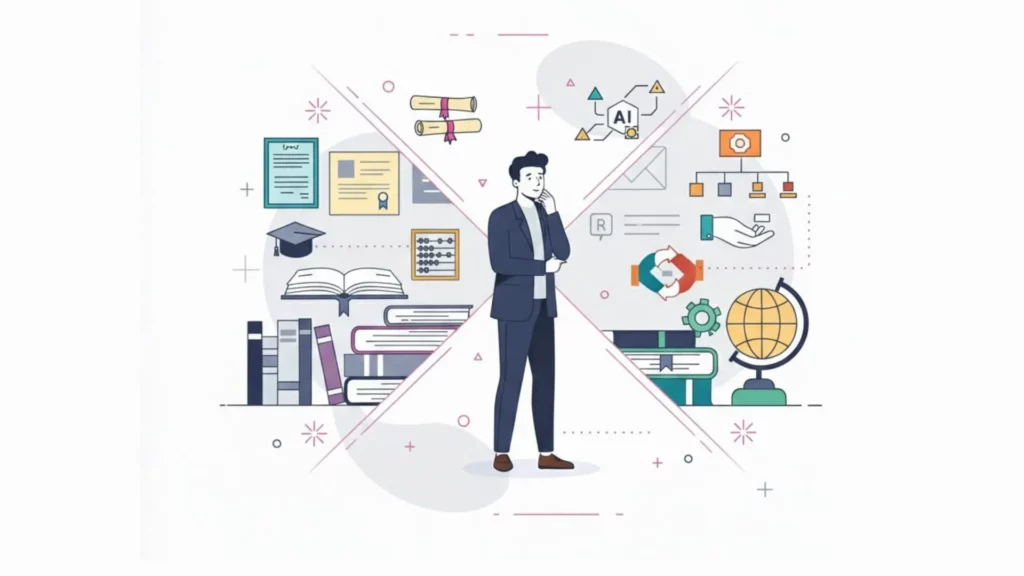
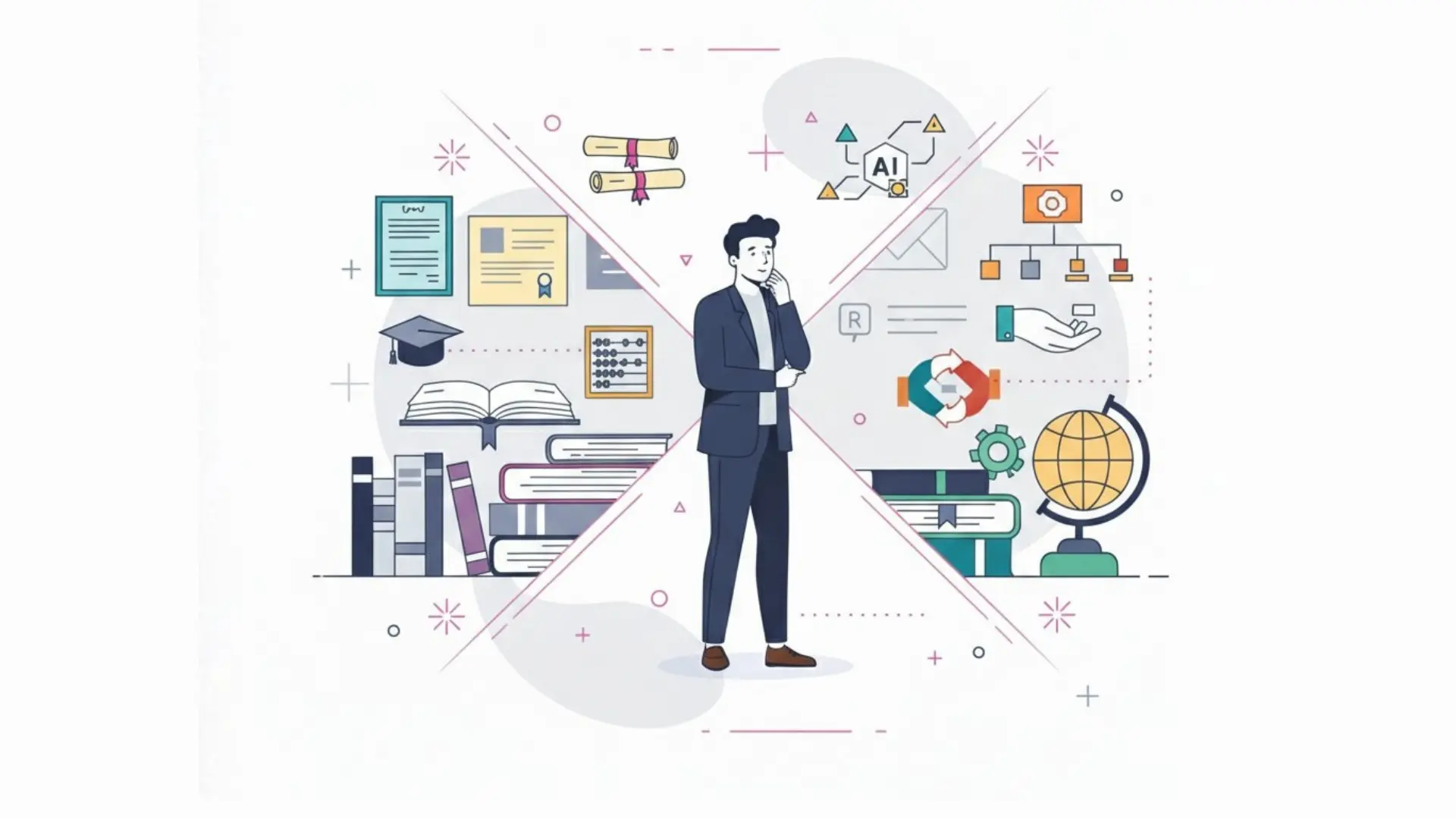
The recent conversations around AI and future skills, including a report from Wharton and Accenture, have once again put a familiar question back on the table:
What skills will matter in the future of work?
Most of the discussion, understandably, focuses on technology. AI literacy. Data fluency. Prompting. Automation. Augmentation. Entire lists of “skills to learn before it’s too late” circulate every few weeks.
But there’s a quieter, more uncomfortable question underneath all of this, one we rarely examine honestly:
Are we confusing education with employability?
AI is exposing a gap we have lived with for years
AI did not create the gap between education and employment. It is simply making it harder to ignore.
For years, organisations have quietly absorbed the cost of this gap. Fresh graduates arrived with degrees but little ability to apply judgment, work with ambiguity, or operate independently. Companies trained them, shaped them, and hoped they would eventually grow into the role.
That arrangement is breaking down.
When technology cycles were slower, businesses could afford this lag. Today, when tools, markets, and roles evolve every few years, the expectation has shifted. Employers are no longer just looking for knowledge. They are looking for readiness.
AI accelerates this shift because it changes the nature of work itself. When tools can generate answers, code, designs, or analysis, the differentiator is no longer information. It is sense-making. Judgment. Decision-making. The ability to work with incomplete data and still move forward.
Ironically, these are precisely the capabilities our education system has struggled to build.
Degrees were never meant to do this job alone
To be fair, degrees were not designed to guarantee employability. They were meant to signal exposure to a body of knowledge, discipline, and effort. Somewhere along the way, we quietly turned them into proxies for capability.
That shortcut worked when demand outstripped supply, and when jobs were more stable and predictable. It works far less well today.
In many developed economies, young people do not default to college automatically. They often work first, explore different roles, or apprentice in real settings before committing to formal education. When they do return, it is usually with clearer intent, about both what they want to learn and why.
In India, the path is far more linear. School. College. Master’s Degree. Job. The degree becomes not just a qualification, but a social signal, a safety net, and a sorting mechanism.
The problem is not education itself. The problem is that we have overloaded it with expectations it cannot realistically meet on its own.
What employers actually struggle to find
If you speak to business leaders across sectors, especially in traditional or people-intensive industries, a pattern emerges quickly.
The struggle is not a lack of intelligence.
It is not even a lack of effort.
It is a lack of applied capability.
People who can take ownership without constant supervision. People who can figure things out rather than wait for instructions. People who can work with constraints, trade-offs, and imperfect information. People who can communicate clearly, learn quickly, and adjust course when reality changes.
These are not abstract traits. They show up very concretely in everyday work.
Who reaches out to a customer without being told.
Who follows through when things get messy.
Who uses tools, including AI, not just to look smart but to get things done.
Who is comfortable saying, “I don’t know yet, but I’ll find out.”
None of these are guaranteed by a degree. And yet, we continue to treat degrees as the primary hiring filter.
The dignity of skills, not just credentials
One uncomfortable aspect of this conversation is how we value different kinds of work.
Incomes today often scale not with degrees, but with speed, skill, and demand. Skilled trades, service roles, and operational work frequently generate higher and more immediate returns than many entry-level degree-based jobs.
This is not a failure of young people. It is a mismatch between aspiration, signalling, and reality.
We still equate education with status, and skills with fallback options. Parents push children toward degrees because that is what social mobility has historically required. Employers complain about unemployable graduates while continuing to hire based on credentials.
Everyone participates in the cycle, even when they privately recognise its flaws.
What we are really missing
At its core, the gap between education and employability is not about syllabus or subjects. It is about how people learn to operate in the real world.
Most formal education systems reward correctness over judgment. Answers over questions. Individual performance over collaborative problem-solving. Predictability over ambiguity.
Work, especially modern work, demands the opposite.
AI makes this even more pronounced. When tools can generate answers instantly, the real value shifts to asking better questions, choosing what matters, and deciding what to do next.
This is where employability is increasingly shaped, not by what you know, but by how you think and act.
Rethinking the path forward
This is not an argument against education. Nor is it a romanticisation of skill over study.
Formal education still matters. Deep expertise still matters. Research, theory, and structured learning are essential for many fields.
What needs rethinking is sequencing and signalling.
What if education and work were more deliberately interwoven?
What if early careers emphasised exposure, apprenticeship, and responsibility, not just credentials?
What if employers reduced their dependence on degrees as a blunt filter, and invested more thoughtfully in assessing capability?
What if parents measured progress not only by marks and admissions, but by confidence, agency, and real-world competence?
These are not easy shifts. They require social change, not just policy change.
Where AI fits into this picture
AI, in many ways, is forcing this conversation earlier than we expected.
It rewards people who are curious, adaptive, and willing to experiment. It punishes those who wait for perfect instructions. It amplifies agency, not passivity.
Those who treat AI as a thinking partner, a productivity aid, or a way to explore faster will move ahead quickly. Those who treat it as a threat, or a shortcut to appear capable, will struggle.
The irony is that AI makes traditional credentialism even less relevant, while making foundational human capabilities more important than ever.
A closing thought
The question is not whether degrees will disappear. They won’t.
The question is whether we are willing to admit that degrees alone are no longer sufficient proxies for readiness, capability, or potential.
Between education and employability lies a missing middle, one shaped by experience, agency, judgment, and applied learning.
Until we acknowledge and address that gap honestly, we will keep having the same conversation, just with newer technologies and louder headlines.
And perhaps that is the real skill the future demands: the ability to see what has been missing all along.





Responses