
A Secret of Learning from my Piano Lessons

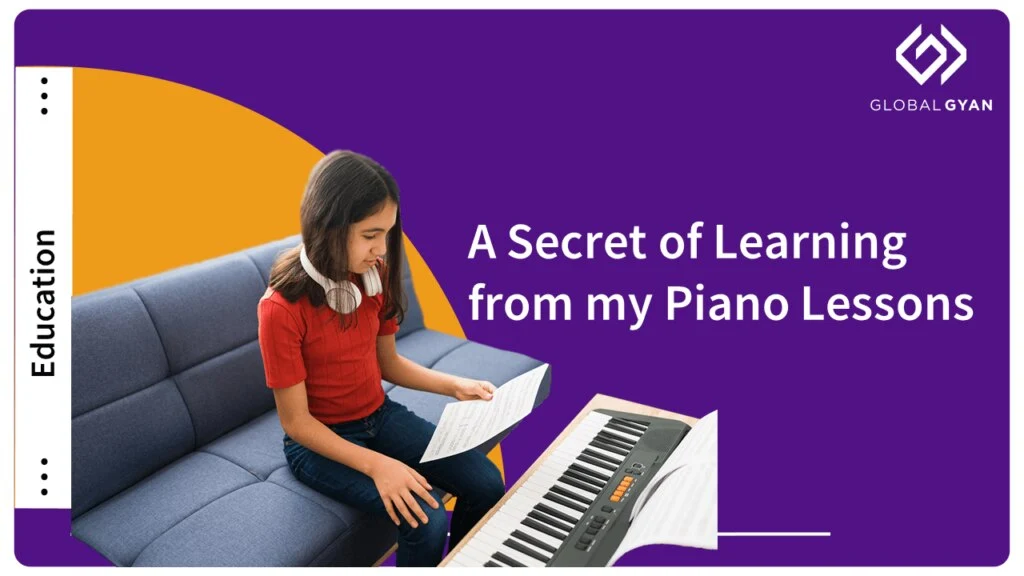
Seven years ago, I started taking piano lessons. That was the first time in my life I was doing any serious learning related to music. Other than just enjoying others performing, I don’t personally have any music capability. But, for various reasons, including giving my daughter company, I enrolled to a weekly class. I don’t know if I learnt much piano but I did discover a secret of learning.
Week after week, for several months, I learnt the notes, the flats and sharps. I did the isometric exercises and moved to chords. With a lot of difficulty, I learnt how to read sheet music. Slowly, we progressed to playing a few short pieces that were part of the Adult Piano book. When I learnt to play Happy Birthday, everyone was sent my piano recording for their birthdays.
Meanwhile, my daughter was making good progress and was planning to take the first level of the tests. Our teacher asked if I wanted to appear for the test, but I was not too sure. It appeared that I was just spending too much time on technical stuff, and I was eager that there was an outcome to the learning.
One day, I asked my teacher if she could teach me to play a real piano piece. She hesitated but I managed to persuade her. We discussed a bit and chose Beethoven’s Ode to Joy as the piece that we would work on. One of the reasons I chose it was also because the Garageband app on the Mac had lessons for it, and I could test myself even when I practised at home.
I don’t remember now how long it took, but it must have been a couple of months before I learnt how to play the first two sections reasonably OK (the third part was too difficult for me). Of course, it was the time then to show off my abilities to others. This included playing it in an informal event and also recording a video of me (actually just my fingers) performing, to share with family and friends.

Everyone was (politely, I think) enthusiastic in commending my effort and I felt really good. That’s when I told my teacher,
We should have just focused on learning such familiar pieces right from the beginning. That would have been more effective.
I don’t remember if she actually said anything in response, but I do remember she smiled.
A Few Years Later
I had my epiphany recently when I was teaching a series of three sessions on financial acumen and business models. The first session was quite conceptual including basic financial ideas and the structure of a business model. In the second session, we applied those ideas to the participants’ industry and company.
The client L&D head shared the participants’ feedback that they had enjoyed the second session a lot and had suggested that we could have skipped the first session and done more stuff similar to the second.
My initial reaction when I read the email was extreme irritation. Then, as I reflected on the feedback, I realised that it was exactly the same experience that I had during the piano lessons.
Learning has become like day-trading. We all want immediate results. We need to show off the outcome. There is no patience to invest in something that may yield benefit later.
Secret of Learning
The secret of learning is that it is built on deep foundations. If you don’t build the foundation, everything else on top is flaky.
This is particularly true for new / unfamiliar skills, like music was in my case and finance was for those managers. Without learning the ABCDs, we wish to write an essay. You can see it around you all the time. Whether it is at school level or corporate training, we want to move to experiential learning. Of course, that is necessary but only if the foundation has been built.
Learning does not happen by watching someone else’s experiences. Learning does happen through personal experiences, but takes time. An efficient form of learning is when others’ experiences are converted into systems or algorithms, you learn the ‘theory’ of how to do it, and then apply in to your own context.
The development of theory or system of learning is critical. Experiential learning must be built on that foundation.
What Learning Designers / Facilitators Must Do
- Include the appropriate concepts and theories that are critical to the learning objectives
- Teach the concepts with appropriate examples, to showcase how they are applied in real-life
- Showcase the importance of theory without idolising it
- Encourage the application of the theory by the learner, through exercises, role-plays, assignments
- Help the learner build their own theory or algorithm of doing things
What Learners Must Keep in Mind
- Reduce your disdain for theory (or “rote-learning”); just because it has been taught poorly in the past does not reduce its importance
- Be ready to question a theory or a framework – explore if it can be modified in your context
- Through your experiences, either reinforce the theory or develop a new one. Share your experiences in the form of theories rather than just stories.
A balance of theoretical rigour and practical application is the secret to real, lasting learning. The best teachers are great both. The best learners have the patience for both.

Srinivasa is the Founder and CEO of GlobalGyan Leadership Academy and a business strategy and leadership development expert with over two decades of experience across telecommunications, consulting, and management education. He spent close to a decade at Tata Communications as Chief Strategy Officer, leading corporate strategy, M&A and investments, and was earlier with Tata Strategic Management Group and the Tata Group's telecom entities, where he executed acquisitions including Tyco Global Network and Teleglobe. An engineering graduate from SVNIT Surat with an MBA from IIM Ahmedabad, Srinivasa is visiting faculty at IIM Ahmedabad, IIM Nagpur, IIT Hyderabad, NMIMS, and TAPMI, and an award-winning case author whose case on business ethics was the overall winner at the ISB-Ivey Global Case Competition 2014. He brings deep expertise in strategy, business acumen, innovation, and leadership communication.
View LinkedIn Profile
 GlobalGyan Leadership Academy