
Leadership Leverage: The Most Strategic Thing You can do with Your Time

In a recent workshop, I asked Manish Shah, CEO of Godrej Capital to share his views on strategy with the senior leaders who were attending the learning session.
He spent most of his time talking about… time.
Not vision statements. Not market share. Not “transformation.” Just a deceptively simple leadership question:
“Where is my time going and what value am I actually adding as a leader?”
That reminded me of a point that Suraj Moraje, former CEO of Quess Corp. makes repeatedly in our strategy workshops:
“The most important decision you make is how you manage your calendar.”
Because in the end, leaders don’t just manage businesses. They manage attention, energy, decisions, and trade-offs. And the calendar is where all of that shows up. Unfiltered.
Time is not a productivity problem. It’s a strategy problem.
The Busyness Epidemic
Most leaders complain about time. “No bandwidth.” “Too many meetings.” “Firefighting.”
Fair. But here’s the uncomfortable bit.
We treat time, the scarcest corporate resource, like an operational inconvenience, not a strategic asset. We throw tools at it (to-do lists, hacks, apps, assistants). Or even stretch ourselves into the weekends. Or 70-hours.
But we don’t bring intelligence to it. Or data. Or ruthless prioritisation.
Imagine running your company without tracking cashflow, margins, or working capital. Then why would you not track leadership time?
The calendar reveals your strategy, whether you like it or not.
You can tell me your strategy deck. Or you can show me your calendar for the last 4 weeks.
One of those is more truthful.
Because strategy is not what we say we will do. It is what we fund, and time is funding.
If your stated priorities are “growth” and “innovation” but your calendar funds only reviews, escalations, and internal politics… you already know the real strategy.
Introducing: Leadership Leverage
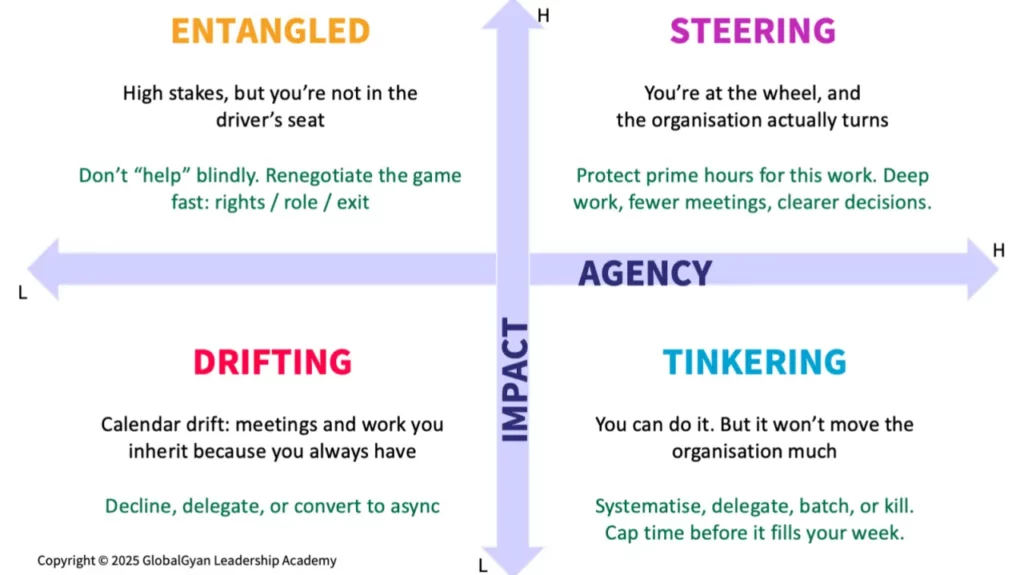
I’ve developed a simple framework for senior leaders to audit and redesign their time. I call it the Leadership Leverage matrix.
It’s a practical alternative to the Eisenhower Matrix, because “urgent vs important” breaks down in modern organisations:
- Everything can be argued as important.
- Everything arrives with a sense of urgency.
So instead, we use two sharper lenses:
1) Organisational Impact (High / Low)
If this goes well, what meaningfully changes?
- A top metric / strategic bet?
- A key customer outcome?
- A critical capability?
- A cultural shift?
- A recurring constraint?
2) Leader Agency (High / Low)
Do I genuinely have the ability to drive the outcome?
Agency is a mix of:
- Authority (decision rights / resources)
- Capability (context and competence)
- Leverage (my involvement changes the result meaningfully)
As expected, this gives us four quadrants:
1) Steering (High Impact / High Agency)
This is where leaders earn their salary.
Examples: strategic choices, being the brand ambassador with key stakeholders, resource trade-offs, key hires, high-stakes customer decisions, resolving cross-functional conflicts.
What it feels like: You’re at the wheel, and the organisation actually turns.
What to do with your time: Protect prime hours for this work. Deep work, fewer meetings, clearer decisions.
2) Entangled (High Impact / Low Agency)
High stakes, but you’re not in the driver’s seat. This is where leaders get dragged into politics, escalations, and “presence tax.”
Examples: “Please bless this,” crises owned elsewhere but escalated to you, stakeholder demands where you lack decision rights, ambiguous accountability.
What it feels like: You’re accountable in perception, but not empowered in reality.
What to do with your time: Don’t “help” blindly. Renegotiate the game fast:
- If I’m accountable, I need decision rights + resources.
- If I don’t have agency, define my role as advisor, not owner.
- Or exit cleanly.
3) Tinkering (Low Impact / High Agency)
You can do it. You’ll do it well. But it won’t move the organisation much.
Examples: polishing slide decks, perfecting internal processes no one adopts, tinkering with templates, over-engineering.
What it feels like: Productive, satisfying… and strategically irrelevant.
What to do with your time: Systematise, delegate, use AI, or kill. Cap this quadrant before it expands to fill your week.
4) Drifting (Low Impact / Low Agency)
This is calendar drift: meetings and work you inherit because you always have. Others control your time.
Examples: FYI meetings, repetitive reviews with no decisions, rituals, being pulled in due to hierarchy.
What it feels like: Activity without contribution.
What to do with your time: Decline, delegate, or convert to async. If nothing is decided, it’s not leadership, it’s attendance.
How to use Leadership Leverage (in 30 minutes a week)
Here’s a simple weekly ritual. If you plan this well, you can get AI to help you do the first step without much effort.
Step 1: Audit last week (10 minutes)
List your meetings and key work blocks. Tag each as:
- High/Low Impact
- High/Low Agency
Step 2: Apply the four moves (15 minutes)
- Increase and protect Steering
- Renegotiate Entangled
- Cap Tinkering
- Delete/convert Drifting
Step 3: Rebuild next week (5 minutes)
Put the high-impact/high-agency (Steering) work first.
Not after your calendar gets hijacked.
The Real Question for Leaders
Leadership is not about being busy.
It’s about being useful, at the highest level of leverage.
So here’s a question worth sitting with:
If your calendar is a mirror of your leadership… what is it currently revealing?
And more importantly:
What would have to change for your time to reflect your strategic intent?





 GlobalGyan Leadership Academy
Responses