
Why Indian Managers Don’t See Themselves in Western Case Studies — A 2026 Guide to Leadership Development in India

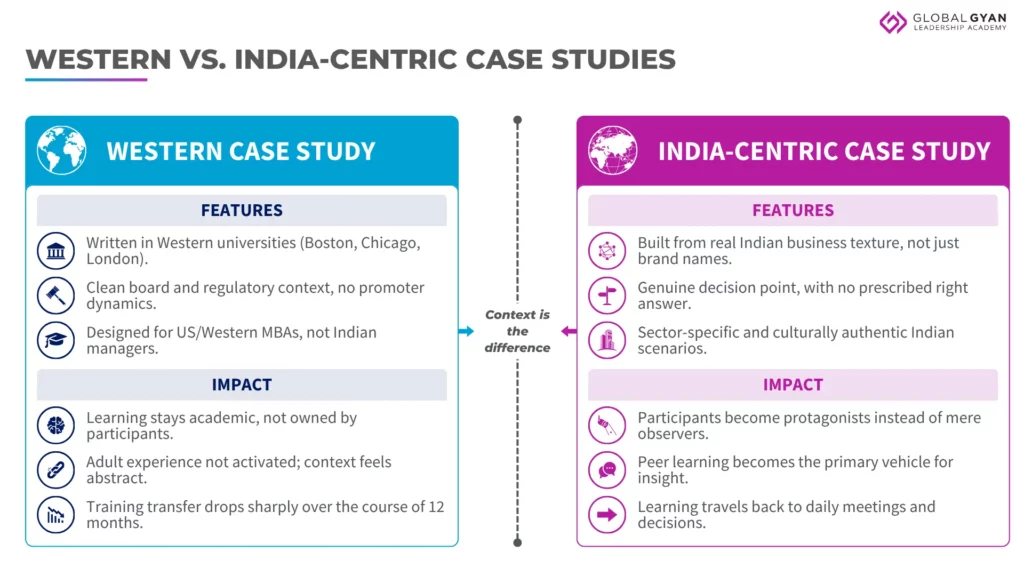
This article examines why most corporate leadership programs in India are built on Western case studies — and why that is a learning science problem, not just a content preference.
- — It draws on adult learning theory, peer-reviewed training transfer research, and verified data from Indian management institutions.
- — You will learn what makes a case study genuinely contextual for an Indian manager, what India-centric program design looks like in practice, and which questions to ask any leadership development partner before committing to a program.
Radhika, a regional operations head at an FMCG company in Nagpur, is attending a two-day leadership program. The case study on the projector is about a GE business unit restructuring in Cincinnati. The facilitator asks: “What would you do in the protagonist’s shoes?” Radhika looks at the slide. The board dynamics are alien. The regulatory environment is clean and uncomplicated. The org structure has none of the promoter relationships she navigates every week. She writes something in her notebook. The session ends. And this is the quiet, recurring failure at the heart of leadership development for managers in India: learning happened, technically, but application? Almost certainly not.
Table of Contents
- The Scale of the Investment and the Irony at Its Heart
- The Case Study Problem: What's Actually in the Room
- This Isn't a Content Preference, It's a Learning Science Problem
- What Makes a Context "Indian" for a Learner?
- What India-Centric Leadership Development Actually Looks Like in the Classroom
- The Open Forum — Why There's No Right Answer
- What to Ask Your L&D Partner
- FAQ Section
THE SCALE OF THE INVESTMENT AND THE IRONY AT ITS HEART
India is making a serious bet on managerial development. The corporate training market reached USD 12.2 billion in 2025 and is projected to reach USD 39.9 billion by 2034 at a CAGR of 12.86%. The executive education and leadership-focused segments alone was valued at US$2.3 billion in 2025.
That is a staggering commitment. And yet, across the leadership development programs that carry this budget, there is a fundamental structural flaw: India is spending billions to develop its managers using stories about companies and contexts most of them have never inhabited.
The case studies fuelling these programs were, in the majority of cases, written at universities in Boston, Chicago, or London. They were researched by faculty whose reference point is the Fortune 500 or the FTSE 100. And they are now being delivered to a mid-manager at a family-run manufacturer in Ludhiana or a branch head at a regional bank in Ahmedabad. Both are sharp. Both are motivated. But they are being asked to see themselves in a story that was never written for them.
THE CASE STUDY PROBLEM: WHAT’S ACTUALLY IN THE ROOM
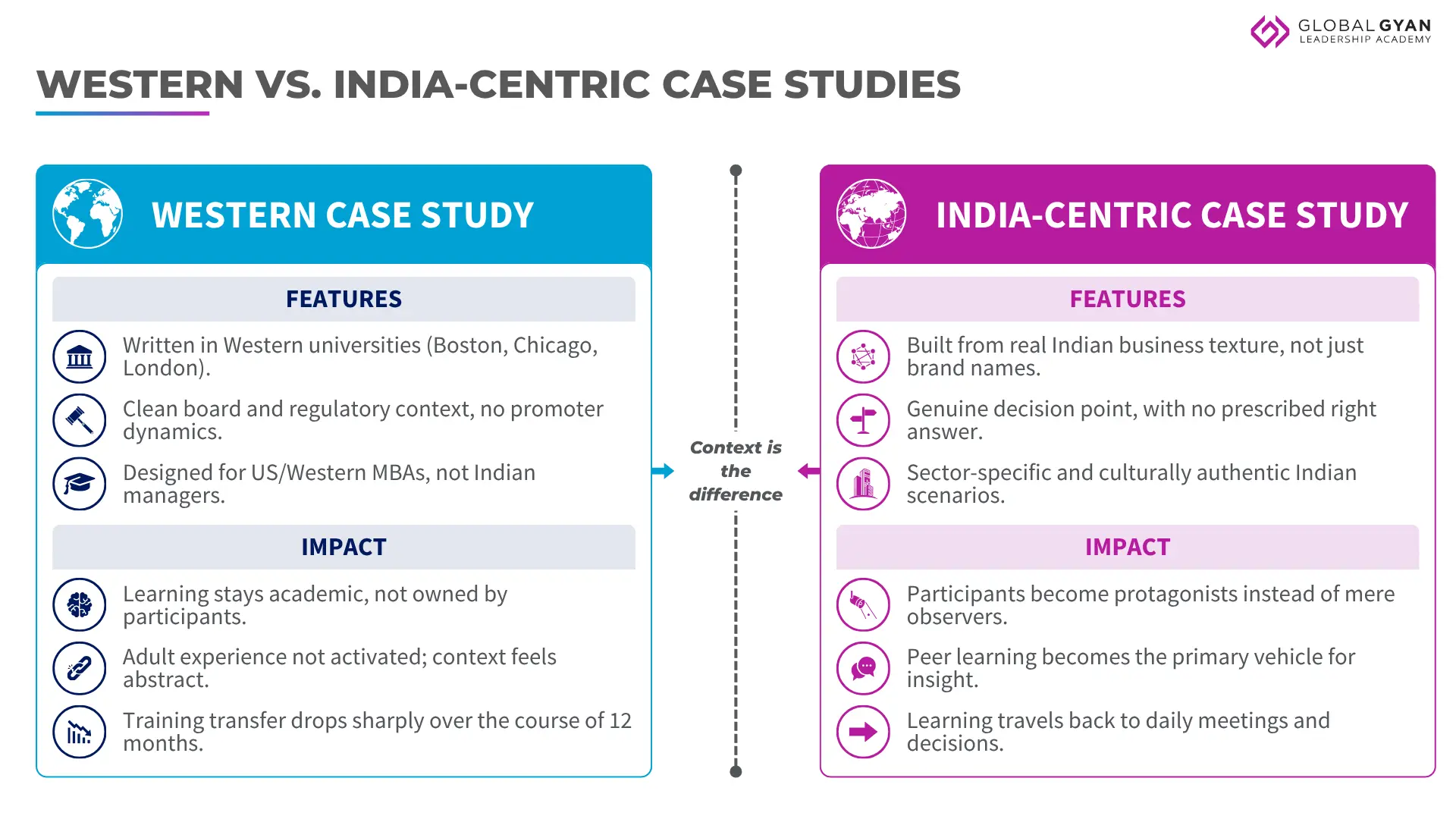
How deep does this go? The numbers are sobering.
Ashok Banerjee, Dean of New Initiatives at IIM Calcutta, has stated on record: “95 per cent of the cases that we use are written in places like Harvard”. This is not a fringe criticism. It is an insider acknowledgement from one of India’s most respected management institutions.
Oxford Academic’s Indian Business Case Studies (2022) is even more direct, acknowledging “a severe shortage in Indian Business Case Studies faced by B-schools in India”, and noting that the majority of cases used at IIMs and other top B-schools are drawn from foreign industries with “very little or no relevance to Indian business situations”.
Harvard Business School publishes more than 150 cases on Indian companies. But the largest consumers of those India-focused HBS cases are American business schools, not Indian ones! That distinction matters enormously. The case study methodology adopted by these programs was not designed for this audience. A case about an Indian company written to help a US MBA understand India as an emerging market is not the same thing as a case written to help an Indian manager lead within it. The intent shapes everything: the dilemma selected, the data surfaced, the questions the facilitator is trained to ask.
IIMB’s own Management Review has described India’s management education as marked by “wholesale copying of the Western curriculum”. These are not external critics. These are Indian institutions naming the problem from inside the building.
THIS ISN’T A CONTENT PREFERENCE, IT’S A LEARNING SCIENCE PROBLEM
Let’s be clear about something first. This is not about cultural nationalism or a preference for “made in India” branding. This is a learning science problem. And there is fifty years of research behind why it matters.
Andragogy, the science of adult learning as developed by Malcolm Knowles, is foundational here. Adults are not passive recipients of content. They bring prior experience to every learning room. They are motivated by material that connects to their specific context. They are problem-centred, not content-centred. And they need to understand why they are learning something before they engage meaningfully. When a case is set in a Silicon Valley boardroom, it quietly violates each of these principles for the average Indian manager. The prior experience cannot be activated. The context cannot be connected. The problem feels abstract.
The data on training transfer makes the stakes even more visible. A peer-reviewed study of 150 organisations found that while 62% of employees apply training immediately after completing it, this drops to 44% at six months and just 34% at one year. Two-thirds of your training investment disappears within twelve months. The primary driver of this decay is the disconnect between the training environment and the learner’s real-world context.
Brion (2022), writing in the Journal of Professional Development, put it plainly: “culture is a predominant force in people’s lives” and L&D that ignores cultural fit will fail to achieve meaningful return on investment. When a case is culturally distant, something specific happens in the room: participants analyse the scenario as an intellectual exercise. They do not treat it as a problem they actually own. The thinking stays academic. And academic thinking rarely survives the commute home.
WHAT MAKES A CONTEXT “INDIAN” FOR A LEARNER?
Not every case written about an Indian company is contextually Indian. And the reverse is true too. The best India-centric cases are not built around brand names. They are built around the texture of business life that Indian managers navigate every day. Here is what that texture actually looks like:
- Deep hierarchy and deference culture. Decisions flow from the top. Navigating upward, i.e., pushing back without being seen as insubordinate, is a skill most Indian managers learn painfully on the job. Almost no Western case study teaches it.
- Relationship-first business dynamics. Trust before transaction. Long-term bonds over short-term efficiency. A vendor relationship built over a decade in Surat is not a procurement contract, it is an asset that does not appear on any balance sheet.
- Constraint-driven problem solving. The instinct for doing more with less is not a workaround, it is an ingrained discipline. Cases must honour this, not treat resource constraint as a failure state.
- Regulatory ambiguity and complexity. Indian managers routinely operate where the rules are inconsistent, contested, or arrive mid-project. A case built around clean, predictable regulatory clarity trains entirely the wrong muscle.
- Family business and promoter-led governance. A significant portion of India’s corporate sector is still shaped by promoter authority. Loyalty, succession, and strategic direction work very differently here than in publicly-listed multinationals with independent boards.
- Generational fault lines. Managing a Baby Boomer senior and a Gen Z reportee in the same team with entirely different expectations of authority, feedback, and communication is a daily reality for Indian managers. Few Western cases even acknowledge this tension exists.
WHAT INDIA-CENTRIC LEADERSHIP DEVELOPMENT ACTUALLY LOOKS LIKE IN THE CLASSROOM
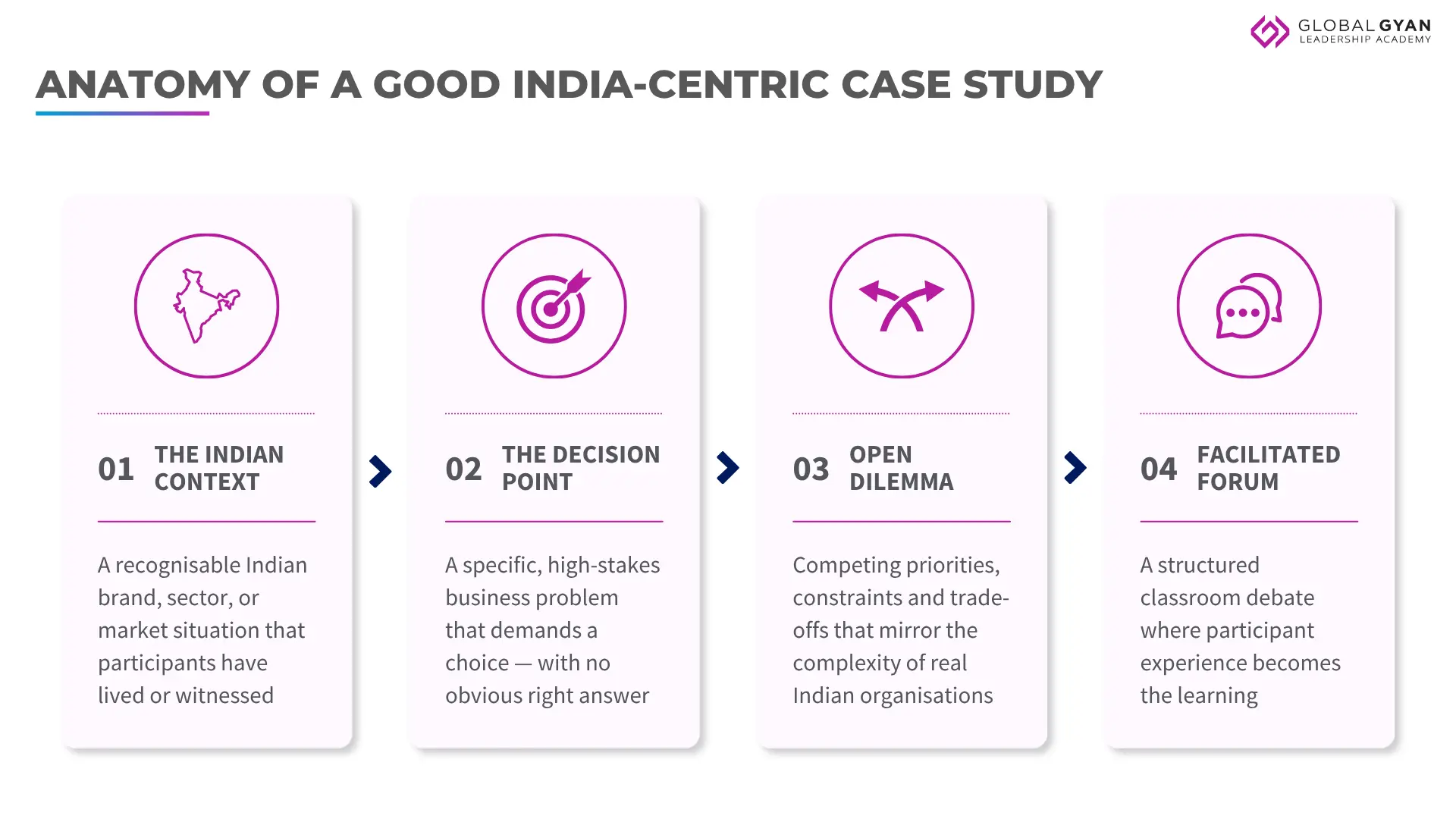
Over the past decade, we at GlobalGyan have built 150+ India-focused cases, each built around a methodology that prioritises open-ended debate over prescribed answers. They are sector-specific and culturally authentic, drawn from real Indian business dilemmas, not adapted Western cases with Indian names substituted in.
But here is what distinguishes them structurally: they deliver no verdict. Each case is built around a genuine decision point; a manager facing an impossible expansion target, a brand caught between aspirational and affordable, a retailer navigating channel conflict from the rise of quick commerce. There is no prescribed right answer. The case exists solely to provide material for class discussion. The author does not intend to illustrate either effective or ineffective handling of the situation.
The sectors are deliberately familiar: value retail, premium brand positioning in Indian sportswear, market entry and localisation, consumer experience design for Indian jewellery buyers, brand refresh in the Indian women’s watch segment. When a participant reads a case and thinks “I know that market” or “I’ve seen that exact dynamic,” the conversation shifts. They stop being observers and start being protagonists.
That is the design intent. The case is not a lecture with a punchline. It is a dilemma with consequences.
THE OPEN FORUM—WHY THERE’S NO RIGHT ANSWER
When the room shares the Indian business context, something changes.
A participant from a consumer goods company in Mumbai does not just analyse the case, she compares it to a pricing decision she made last quarter. A finance manager from a mid-size manufacturer in Coimbatore does not just evaluate the protagonist’s choices, he argues with them, drawing on his own experience with a distributor dispute that played out almost identically. The peer group does not merely learn from the case. They learn from each other.
This is what peer learning in corporate training actually looks like; not a discussion exercise bolted onto content delivery, but the primary vehicle for learning itself. Our programs are built around structured conversations that help leaders surface their assumptions, understand their leadership identity, and examine how their style lands with others.
The learning does not happen in the answer. It happens in the debate. And that debate is richer, more honest, and far more transferable when everyone in the room has lived some version of the same dilemma.
WHAT TO ASK YOUR L&D PARTNER
Before you sign off on a leadership development program, put these five questions to any vendor and listen carefully to how they respond.
- “Are your case studies Indian business dilemmas or Western cases with Indian names swapped in?” The difference matters. One activates lived experience. The other produces academic analysis that evaporates by the end of the week.
- “How do you measure transfer back to the workplace and not just satisfaction scores?” Training ROI is not a feedback form. It is application data at three months, six months, and beyond.
- “Who designed your curriculum and what is their specific experience within Indian organisations?” International consulting experience is not the same as deep familiarity with how Indian organisations actually function.
- “What percentage of your program is built on cases your participants will recognise, not just cases your faculty are comfortable teaching?” Recognition is not vanity. It is the activation trigger that makes adult learning work.
The bottom line is, most leadership programs running in Indian organisations today have a structural gap. It is not a gap in intent. It is not a gap in delivery quality. It is a gap in context. When the case is foreign, the learning stays foreign. When the case is genuinely Indian (and not just India-labelled), the learning travels back with the participant to every meeting, every difficult conversation, every decision they face in their actual organisation.
Leadership development training in India need not keep making this mistake. If you are thinking about your leadership development architecture and want a conversation about what contextual relevance looks like in practice, we would welcome it. Reach out to our representative today and let’s build something that actually sticks.
FAQ SECTION
Q1. What are the most effective leadership development programs in India for mid-level managers?
Leadership development programs in India are most effective when they combine India-specific case study methodology with peer learning in corporate training, ensuring managers can apply insights directly to the hierarchies and constraints of their own business reality.
Q2. Why does leadership development training in India still rely heavily on Western case studies?
Leadership development training in India has defaulted to Western cases because of a severe shortage of India-specific case material — with over 95% of cases used at top Indian business schools originating from institutions like Harvard.
Q3. How does andragogy inform the design of leadership training for managers?
Andragogy establishes that leadership training for managers achieves the strongest outcomes when it connects directly to the learner’s prior experience and real-world context, making India-centric case studies essential rather than optional.
Q4. What is case study methodology and why is it central to leadership development training?
Case study methodology is an open-ended, discussion-based learning approach that trains participants to navigate real business dilemmas — and it works best in leadership development training when cases reflect the learner’s own cultural and industry context.
Q5. What role does peer learning in corporate training play in leadership development programs?
Peer learning in corporate training is the mechanism through which leadership development programs generate real workplace transfer, because participants debate shared Indian business dilemmas and surface assumptions from their own lived experience rather than analysing abstract scenarios.
Q6. What should CHROs look for when evaluating leadership development programs in India?
When evaluating leadership development programs in India, CHROs should ask vendors to demonstrate a library of India-specific case studies with no prescribed right answers, and to provide training transfer data at six and twelve months — not just satisfaction scores.
Q7. How does andragogy explain why culturally distant case studies undermine leadership development training?
Andragogy shows that adults learn best from material connected to their prior experience, so leadership development training built on foreign business contexts fails to activate the problem-solving instincts and contextual knowledge Indian managers already possess.




 GlobalGyan Leadership Academy
Responses