
The Promotion Trap: How India’s Performance Management Systems Are Failing People Managers in 2026

- — India's top individual contributors can struggle after promotion when strong past performance is mistaken for readiness to manage people.
- — Appraisal systems often continue to reward individual output, even after the role has shifted towards team performance, coaching and people leadership.
- — People managers must navigate a major identity shift, alongside the realities of hierarchy, feedback and decision-making in Indian organisations.
- — Manager metrics need to evolve after promotion, with greater emphasis on team outcomes, behaviour change and stakeholder feedback.
- — Structured people manager journeys, sustained over time, are more likely to support workplace application than one-off workshops.
Table of Contents
- The Hidden Cost of the Promotion Trap
- Why High Performers Struggle as First-Time Managers in India
- The System Design Problem
- What Effective Development Programs for Managers Do Differently
- Designing Metrics and Appraisals That Don't Punish New Managers
- How GlobalGyan Supports People Managers in India
- The Trap Is Designed, Not Inevitable
- FAQs
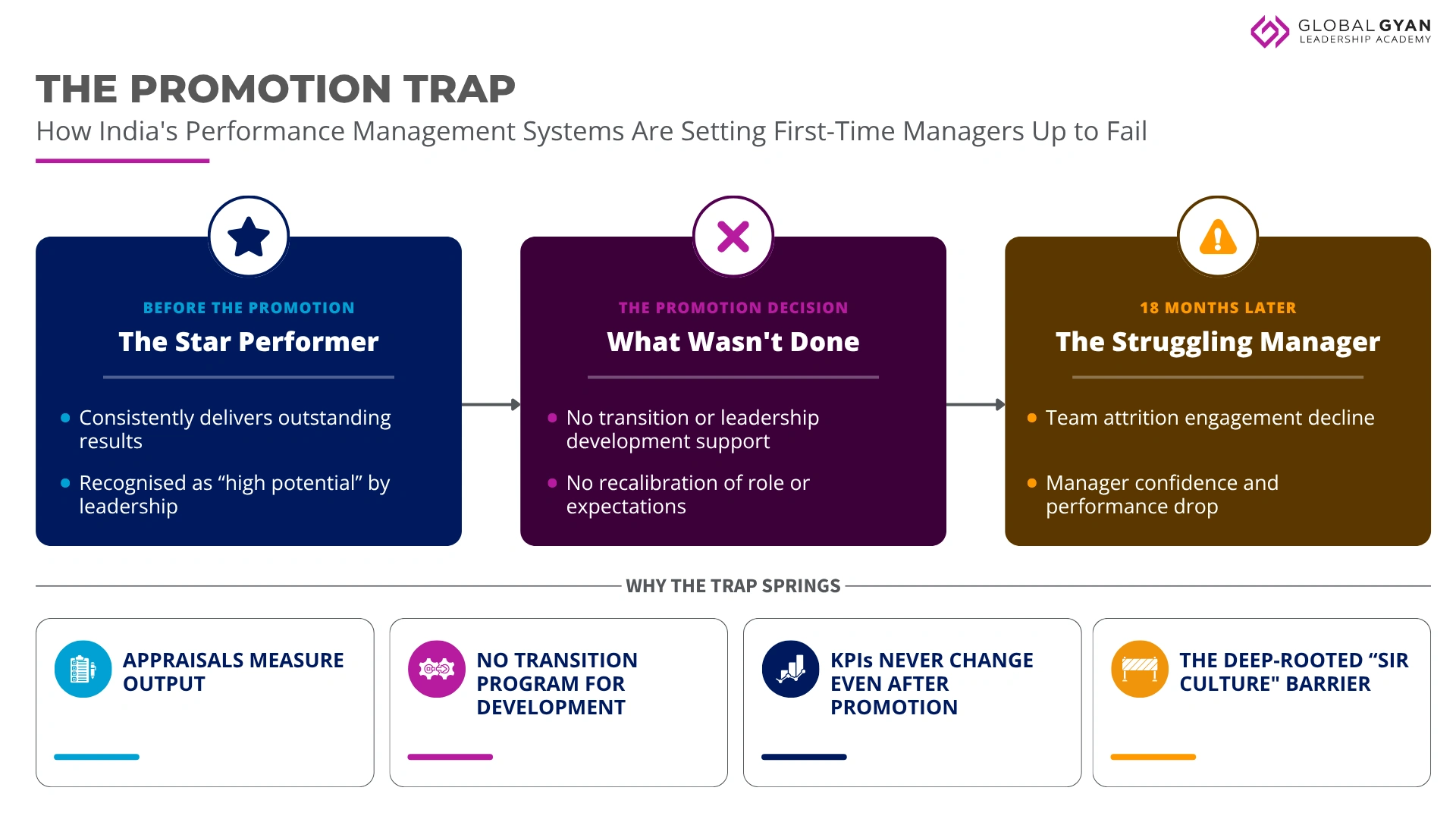
India’s performance management culture has a blind spot, and it shows up most painfully at the moment of promotion. Take for instance the case of Rahul Dutta. Rahul was everything a leading BFSI organisation in Mumbai wanted in a senior analyst. For six years, his output was impeccable: clean numbers, loyal clients and enviously good ratings. So, the organisation did what most Indian companies do with their best people: they promoted him. As an emerging leader, Rahul’s next 18 months were fraught with tensions. His team’s attrition had crossed 35%, skip-level meetings were filled with muted complaints, and Rahul himself, exhausted, confused, and running on borrowed confidence, was updating his résumé.
Nobody had set him up to fail. They had simply forgotten to set him up at all.
The Hidden Cost of the Promotion Trap
The promotion trap is a deceptively simple organisational problem: you lose a great individual contributor and gain a struggling manager. The cost is double. The role is now poorly led, and a high performer’s confidence erodes quietly from the inside.
What makes this trap so persistent is that most performance management systems are designed to reward the past, not predict the future. Appraisal cycles in Indian organisations typically rate individual output: deals closed, projects delivered, targets hit. They rarely assess whether someone can coach a team, give hard feedback, or navigate the interpersonal complexity that defines people management. When the numbers say “promote,” the organisation complies without asking whether the person is actually ready.
Empirical evidence also supports this hypothesis. Gallup’s research found that companies fail to choose candidates with the right natural strengths for manager roles 82% of the time. The same study established that managers account for at least 70% of the variance in employee engagement scores. A struggling first-time manager doesn’t just hurt their own output, they bring down everyone around them, hollowing out the talent management outcomes the organisation has worked hard to build.
Why High Performers Struggle as First-Time Managers
The first shock is identity. For years, Rahul’s value was measured by what he could personally produce. Now his job is to make others productive. That shift, from individual output to people management, is rarely named, let alone prepared for. No one tells a new manager that their technical expertise has just become a secondary asset.
The second shock is the absence of structure. Most Indian organisations do not have a formal people managers program, or as we more commonly know it, a first-time manager program. There is no transition framework, no cohort of peers navigating the same unfamiliar terrain. The new manager figures it out alone, often absorbing habits — good and bad — from whoever managed them.
Misaligned metrics create a third structural layer of confusion. In many organisations, first-time managers remain evaluated against individual contributor targets for twelve months after promotion. Nobody has recalibrated the job against team outcomes. The appraisal still asks: “What did you close this quarter?” It never asks: “How is your team doing?”
Then there is the cultural dimension. Indian organisations carry deeply embedded dynamics around hierarchy and deference: the informal “sir culture” that structures most professional relationships. New managers who spent years deferring to seniority must now give direct feedback to peers who are only marginally junior. Candid conversations feel like overreach. Tough discussions get postponed indefinitely. Underperformers are managed around, not through. And the system, designed without this cultural context in mind, provides no scaffolding for any of it.
The Performance Management System Problem
At the root of most promotion traps is a performance management system designed for individual contributors, and never meaningfully updated for managers.
In a typical Indian mid-sized organisation, the performance appraisal process involves rating employees against functional targets, a bell curve, and a broad competency grid. Hardly ever does it ask: “Is this person ready to lead people?” The system measures arrival, not readiness for what comes next.
The deeper design flaw is how organisations typically define “high potential.” In most such frameworks, potential is inferred from current performance i.e., the employee who scores highest in individual output is assumed to have the highest ceiling. But potential for management is a different dimension entirely. It requires one to be comfortable with ambiguity, have genuine interest in others’ development and tolerance for the slow, indirect work of building a team. These qualities rarely surface in a standard appraisal. In many organisations, the competency section of the form hasn’t been meaningfully updated in years and makes no distinction between the competencies of an individual contributor and those required of a first-time manager.
This creates a structural double bind. New managers are expected to deliver team results but evaluated on personal output. Their review cycle does not account for the learning curve every first-time manager must climb. And when employee engagement drops on their team, the rating process rarely traces the root cause back to under-prepared management. Gallup’s State of the Global Workplace data reinforces this: organisations that do not actively develop their managers report weaker engagement scores and higher voluntary attrition, both of which erode talent management quality over time.
What Effective Development Programs for Managers Do Differently
Organisations that consistently avoid the promotion trap share one thing in common. They treat the move from individual contributor to manager as a transition that requires sustained investment, not a title change followed by silence.
A strong program of this kind in the Indian context does several things well. It explicitly names the identity shift, giving new managers the language to understand that their role has fundamentally changed. It builds people management skills over time: how to coach, how to conduct a difficult performance conversation, how to give feedback, how to delegate, how to follow up, how not to micromanage without triggering defensiveness in a hierarchical culture.
It also works with HR to align the job’s KPIs to team outcomes, like engagement, capability growth, and retention, rather than individual output. Without that realignment, even the best training erodes gradually over time. If performance management for managers still rewards individual contributor behaviour in the appraisal cycle, participants go back to square one the moment they return to their desks.
Sustained journeys outperform one-off workshops. GlobalGyan Leadership Academy’s approach with SANKALP, the people manager program, reflects this evidence. Multi-module programs that weave India-specific case studies, peer cohort learning, reflective assignments, and optional coaching into a single connected arc. Scenarios are drawn from Indian sectors and the organisation’s own challenges. That specificity matters and we’ve covered this in our blog article on why Indian managers don’t see themselves in Western case studies. Leadership development lands differently when the dilemma on the page mirrors the one waiting on Monday morning.
Designing Metrics and Appraisals That Don’t Punish New Managers
The most practical change company HR policies can make costs nothing: stop measuring first-time managers against their individual contributor metrics after promotion.
Build a first-year performance appraisal framework for new managers that balances three things:
- Learning progress: Is the manager demonstrating new management behaviours and engaging with structured development?
- Team outcomes: Is the team’s output, attrition, and employee engagement trending positively?
- Stakeholder feedback: What are direct reports, peers, and senior leaders observing over the first twelve months?
To make this concrete, consider what the shift looks like in practice. In one of our leadership development workshops, Riti, a sales manager in an FMCG company in Pune, was carrying two measures from her individual contributor days into her first year as a team lead. One was monthly revenue target and the other was client retention rate, both personal output metrics. Her redesign with HR added three manager-specific KPIs: the team’s overall revenue performance, a quarterly direct-report satisfaction score, and a coaching check-in completion rate. These new measures immediately changed what she paid attention to each week. Within six months, she had addressed a difficult performance issue she had previously been postponing and agreed a structured improvement plan with the team member. Employee engagement on her team moved from below average to above benchmark by year end.
For more on embedding this kind of structured thinking into a broader leadership development strategy, GlobalGyan’s resources offer practical guidance tailored to the Indian context.
This redesign also sends a signal: that the new manager’s growth is a shared investment, not a personal trial they are expected to pass or fail in silence.
How GlobalGyan Supports People Managers in India
GlobalGyan Leadership Academy has spent over a decade building programs grounded in how Indian organisations actually work, not how Western business schools imagine they might.
Our people manager program, SANKALP, designed for first-time managers, focuses on the real moments that define a manager’s day. Participants work through contextualised scenarios and practise behaviours such as communicating clearly, handling differing views, learning constructively from setbacks and supporting thoughtful risk-taking.
The journey is practice-led, combining experiential sessions, reflection, peer learning and action commitments, with follow-through through peer circles, coaching and manager check-ins to help new behaviours carry into the workplace.
SANKALP integrates people management skill-building, structured reflection, and group discussions and actionable takeaways that new managers can start implementing from day one.
The Trap Is Designed, Not Inevitable
Rahul’s story is not about a lack of ambition or capability. It shows how easily the promotion trap can emerge when organisations recognise performance but do not fully prepare people for the shift into management. Without clearer expectations, manager-specific measures and structured transition support, even high performers can struggle in a role that demands a very different kind of contribution.
Indian organisations have no dearth for talent. What’s missing is the architecture: a performance appraisal process that evolves with roles, metrics that reflect team outcomes, and a program that treats the first management role as the most consequential professional transition in a person’s career.
For the CHROs and L&D leaders reading this: examine your appraisal criteria for new managers. Audit whether your talent management processes include a structured transition journey — or just a congratulatory email. And consider whether an India-native partner like GlobalGyan, one that understands the cultural and structural realities your managers face every day, can help you close the gap before the next Rahul slips away.
FAQ SECTION
- What is the promotion trap in performance management in India, and why does it hurt high performers?
The promotion trap occurs when a performance management system advances top performers based on a performance appraisal that evaluates individual KPIs rather than leadership readiness, leaving new managers to struggle without people management skills, without performance management for managers frameworks, and without an people managers program to guide the transition — steadily eroding employee engagement, weakening the performance management system, and undermining talent management outcomes across the organisation.
- How does an people managers program improve performance management for managers and employee engagement in India?
A well-structured people managers program builds the people management and leadership development capabilities first-time managers need, realigns performance management for managers around team-level KPIs and coaching quality, and directly improves employee engagement by ensuring teams are led by prepared managers supported within a robust performance management system and a broader talent management strategy.
- What KPI and performance appraisal changes should CHROs in India make for first-time managers?
CHROs should redesign the performance appraisal for new managers to track team-level KPIs — including employee engagement scores, attrition rates, and coaching quality — rather than individual output, embedding this shift into the performance management system as part of a leadership development journey anchored in a formal people managers program and sustained people management capability-building.
- How does GlobalGyan’s leadership development for people managers fit into talent management and people management strategies in India?
GlobalGyan’s people managers program integrates India-specific cases, simulations, and coaching with practical performance management for managers, realigned KPIs, and people management skill-building, making it a high-impact anchor within any organisation’s talent management strategy and a measurable driver of employee engagement, performance appraisal improvement, and leadership development outcomes.
- What should a strong performance management system include to support new managers and prevent the promotion trap?
A strong performance management system should distinguish individual contributor KPIs from manager-level KPIs, embed a structured people managers program into the promotion pipeline, redesign the performance appraisal for new managers to track employee engagement and team outcomes, and invest in sustained leadership development and people management training as core elements of an integrated talent management and performance management for managers strategy.




 GlobalGyan Leadership Academy
Responses