
Agency: Why Leadership Is Less About Intelligence and More About Ownership



A few weeks ago, Andrej Karpathy made an observation that stayed with me.
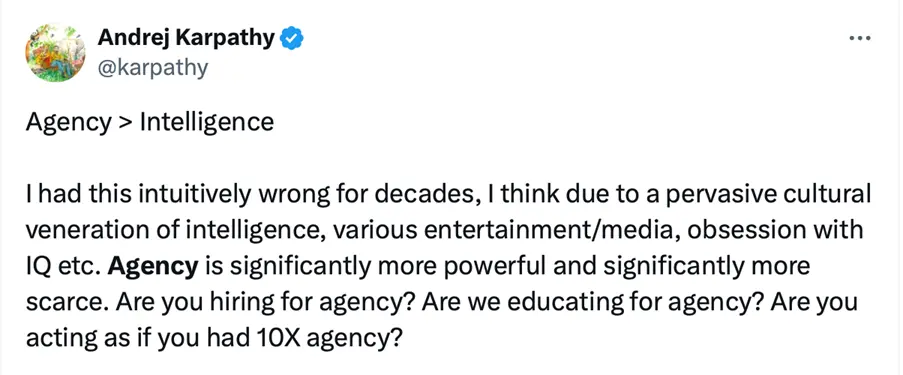
He wrote that for years he believed intelligence was the primary driver of success, until he realised that agency is far more powerful and far more scarce. Intelligence, he argued, is now abundant. Agency is not.
It struck a chord because, in quieter ways, many of us in traditional organisations see the same pattern every day.
Plenty of smart people.
Plenty of articulate analysis.
Plenty of presentations that explain why something is difficult.
And yet, very few people who consistently step forward and say: “I’ll take this on.”
What Do We Mean by Agency?
Agency is not ambition.
It is not assertiveness.
It is not charisma or confidence.
Agency is the belief that I can act, and the willingness to follow through.
People with agency don’t wait for:
- Perfect clarity
- Formal authority
- Explicit permission
They act with what they have, learn along the way, and stay accountable for outcomes.
If intelligence answers “Can I think?”
and growth mindset answers “Can I improve?”
then agency answers the harder question: “Will I act?”
Why Agency Matters in Large, Traditional Organisations
Agency is often associated with founders and startups. That’s a mistake.
In fact, agency is harder, and more valuable, inside established organisations, where:
- Roles are clearly defined
- Hierarchies are strong
- Risk is reputational, not existential
- The cost of standing out feels higher
In such environments, passivity is often rewarded as “professionalism”, while initiative is quietly discouraged as “overstepping”.
Over time, people learn to:
- Wait instead of initiate
- Escalate instead of own
- Explain instead of experiment
What became clear to me through many conversations is that agency is rarely a fixed personality trait.
The same individual may display high agency in one context and near-complete passivity in another, depending on perceived safety, clarity of decision boundaries, and consequences of getting it wrong.
In other words, agency is as much a system outcome as it is a personal choice.
What Agency Looks Like (In Real Life)
Agency is not abstract. It is visible, if you know what to watch for.
Here are some reliable behavioural markers:
- They Put Their Hand Up — Early
People with agency volunteer for new projects or roles before they are asked.
Not because they are reckless, but because:
- They see gaps
- They feel responsible for outcomes
- They are willing to learn in public
- They Act Before Roles Are Perfectly Defined
They don’t wait for a formal mandate to start thinking, drafting, or experimenting.
They understand that clarity often follows action, not the other way around.
In practice, agency becomes visible at the point of trade-offs, when someone is willing to choose, deprioritise, or say no, rather than keep all options alive.
- They Absorb the Cost of Learning
They are willing to:
- Look inexperienced
- Ask naïve questions
- Invest time without immediate payoff
Agency always comes with a personal cost. People without agency avoid that cost.
- They Stay with the Problem
Agency isn’t just starting things. It’s seeing them through when enthusiasm fades and complexity shows up.
They don’t disappear once the idea is approved.
A Personal Reflection on Agency
Early in my career, I remember a phase when many of us were unhappy about the future direction of our organisation.
There was a lot of corridor conversation. Some frustration. A fair amount of passive-aggressive commentary.
At some point, I realised that while we were all talking, no one was actually doing anything.
So I decided to write out what I thought could be a strategic direction for the firm.
I was young. I had no experience with strategy. I didn’t really know what I was doing.
But I read, thought, wrote, and then shared it with the CEO. To my surprise, he engaged seriously with it, offered comments, and encouraged further discussion.
I spoke to other senior leaders. I read a book on internal consulting groups.
Over time, that rough document evolved into a team workshop where we debated and aligned on key choices for the future.
None of this happened because I was the smartest person in the room.
It happened because I put my hand up, stepped into ambiguity, and stayed with it.
That, in hindsight, was agency.
Creating Conditions Where Agency Can Exist
Here’s the uncomfortable part:
Most organisations say they want ownership, but structurally discourage it.
If you want agency, three things matter.
- Don’t Punish Well-Intentioned Initiative
When people take ownership and stumble, the organisational response matters.
If every misstep leads to blame or withdrawal of trust, agency dies quietly.
- Avoid Decoupling Accountability from Control
You cannot demand ownership while retaining tight control over execution.
When accountability is decoupled from decision rights, people retreat into activity optimisation rather than judgment-based trade-offs.
Agency thrives when leaders say:
“You own this. I’m available, but I won’t take it back.”
- Leaders Must Model Agency
Nothing kills agency faster than leaders who:
- Talk about ownership
- Avoid personal risk
- Delegate responsibility upward when things get uncomfortable
Agency is learned by observation, not slogans.
What About People Who Don’t Show Agency?
This is where leadership maturity shows.
Not everyone wants high agency. And not every role requires it.
Some people do excellent work in roles that demand:
- Precision
- Consistency
- Clear instruction
That’s not a failure.
The mistake is forcing everyone into roles that require initiative, or pretending that passivity is a motivation problem.
Where agency is essential, be honest.
Where it isn’t, design roles accordingly.
And when someone consistently avoids ownership in a role that demands it, the most respectful choice may be to redesign the role or help them move on.
The Question Leaders Should Ask
In moments of uncertainty, strategy meetings, or transformation initiatives, there is one question that cuts through everything:
Who is willing to own what happens next?
Not who understands the problem best. Not who has the smartest slide. But who is prepared to step forward, without guarantees.
That quiet decision is agency.
And as Karpathy observed, in a world where intelligence is increasingly commoditised, agency may well be the defining leadership capability of our time.






 GlobalGyan Leadership Academy
Responses