
40 Leadership Quotes and How to Turn Each Into Action in Your Organisation


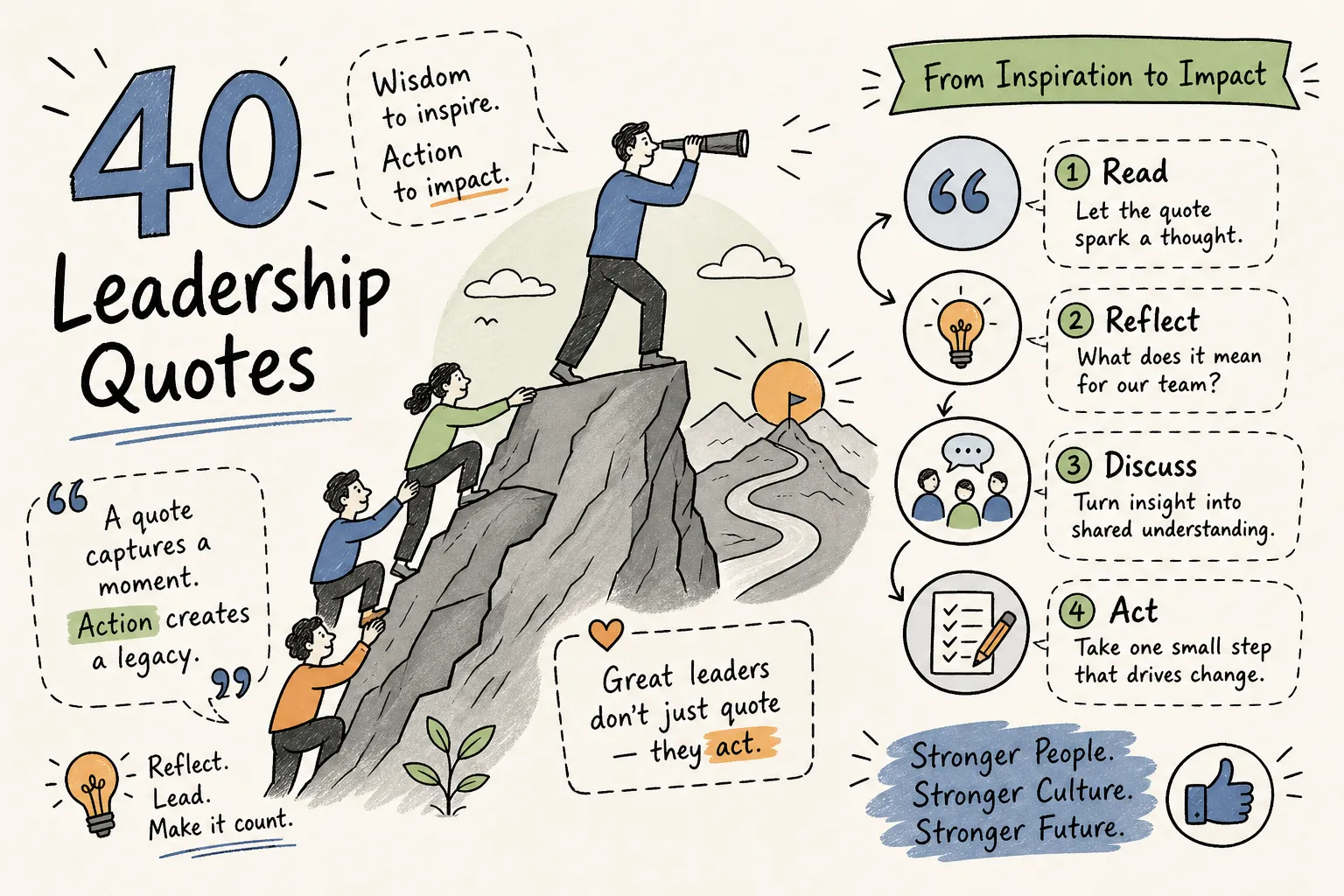
- — Leadership quotes without a behavioural interpretation are decoration — each quote here comes with a concrete action a manager can take this week.
- — Attribution matters: several widely circulated quotes, including those credited to Drucker, Churchill and Gandhi, are misattributed or paraphrased beyond recognition.
- — A three-question framework — what behaviour does it name, what trade-off does it demand, what is the smallest action it requires — converts any quote from inspiration into a leadership decision tool.
- — The 40 quotes span four domains: vision and strategic direction, courage and accountability, servant leadership and trust, and communication and change.
- — A single well-chosen quote, run through the three-question framework with a team, can anchor a 20-minute micro-learning module with minimal preparation.
Table of Contents
- Why Interpretation Matters More Than the Quote Itself
- Leadership Quotes on Vision and Strategic Direction (Quotes 1–10)
- Leadership Quotes on Courage, Accountability and Difficult Calls (Quotes 11–20)
- Leadership Quotes for Teams: Servant Leadership, Trust and Collaboration (Quotes 21–30)
- Short Leadership Quotes on Communication, Influence and Managing Change (Quotes 31–40)
- From Quote to Workshop: How These Lines Become Learning Moments
- Bring It Back to the Whiteboard
- Frequently Asked Questions
Many organisations have leadership quotes on their office walls or embedded in slide decks. What far fewer of them have is a method for converting those words into decisions or behaviour. A senior manager attending a GlobalGyan Leadership Academy workshop once shared that the Peter Drucker quote distinguishing management from leadership had been pinned above her team's whiteboard for three years. Nobody had ever discussed what it meant for the way they ran their Monday meetings. That is the gap this article addresses.
Rather than present 40 famous leadership quotes as a passive reading list, each one here comes with a behavioural interpretation, a decision-making lens calibrated for Indian corporate contexts, and one concrete action a manager can take this week. The format is deliberate. Inspiration without application is just decoration.
Why Interpretation Matters More Than the Quote Itself
Most leadership quotes circulate without context. When a quote is lifted from its original setting, a wartime speech, a commencement address, a practitioner's memoir, it loses the tension and specificity that made it useful. Managers absorb it as motivation, not as instruction. The organising principle of this article is simple: every quote is only as powerful as the behaviour it makes visible.
Attribution matters too, and more than people realise. "Culture eats strategy for breakfast" is routinely credited to Peter Drucker, yet there is no evidence it appears anywhere in his published work; it is traced to Ford executive Mark Fields, who used it around 2006. "Be the change you wish to see in the world" is a paraphrase of Gandhi's broader teaching, not a direct quote. And "Success is not final, failure is not fatal" has no documented connection to Churchill; the earliest complete appearance has been traced to advertising copy from the late 1930s, not to Churchill at all. When a CHRO or senior leader uses a misattributed quote in a public forum, it is a credibility problem, not a pedantic one.
At GlobalGyan Leadership Academy, our practitioners apply a three-question framework before deploying any quote in a workshop, a method developed and refined through practitioner-led programme delivery. First: what leadership behaviour does this quote name or challenge? Second: what trade-off does it ask the leader to accept? Third: what is the smallest action this quote demands of someone in this room, today? The rest of this article applies that framework across all 40 quotes.
Leadership Quotes on Vision and Strategic Direction (Quotes 1–10)
This set covers the territory of direction-setting, purpose, and strategic clarity. These motivational leadership quotes, with attribution confidence noted:
- "Leadership is the capacity to translate vision into reality" — Warren Bennis (widely cited; no confirmed primary source document)
- "A leader is one who knows the way, goes the way and shows the way" — John C. Maxwell (high confidence)
- "Do not follow where the path may lead. Go instead where there is no path and leave a trail" — Ralph Waldo Emerson (high confidence)
- "Where there is no vision, the people perish" — Proverbs 29:18 (high confidence)
- "Vision with action can change the world" — Joel Barker (strong in leadership literature)
- "Leadership is not defined by the exercise of power but by the capacity to increase the sense of power among those led" — Mary Parker Follett (high confidence)
- "A leader is best when people barely know he exists" — Lao Tzu (widely cited; no confirmed primary English translation source)
- "The key to successful leadership is influence, not authority" — Kenneth H. Blanchard (high confidence)
- "Management is doing things right; leadership is doing the right things" — Peter Drucker (high confidence)
- "There are three essentials to leadership: humility, clarity and courage" — Chan Master Fuchan Yuan (moderate; primary-source verification recommended before formal use)
Take Bennis's quote through the three-question framework. The behaviour it names is execution, not aspiration. The trade-off it asks a leader to accept is this: stop perfecting the vision document and start investing in the conversations that make implementation possible. In a large Indian conglomerate, a mid-level general manager used this quote in a GlobalGyan cohort session as a mirror. His team could recite the company vision without pause. When asked to describe their own team's specific contribution to it, the room went quiet. The gap was not vision clarity; it was ownership.
The action for this week: ask each direct report to describe where the team will be in 18 months, in their own words, without referencing any official strategy document. Follow up by asking which part of that future they feel most responsible for making real. What you hear back will tell you exactly where the vision work still needs to happen.
Leadership Quotes on Courage, Accountability and Difficult Calls (Quotes 11–20)
This set addresses the decisions most managers defer, the conversations they avoid, and the moments where leadership becomes uncomfortable. These inspirational leadership quotes for teams:
- "You manage things; you lead people" — Rear Admiral Grace Hopper (widely cited; moderate primary-source confidence)
- "No plan survives first contact with the enemy" — Helmuth von Moltke the Elder (high confidence; often misattributed to Napoleon)
- "A good leader inspires people to have confidence in the leader; a great leader inspires people to have confidence in themselves" — Eleanor Roosevelt (widely attributed; no confirmed primary source)
- "When the whole world is silent, even one voice becomes powerful" — Malala Yousafzai (high confidence)
- "Don't be intimidated by what you don't know. That can be your greatest strength" — Sara Blakely (high confidence)
- "Lead me, follow me, or get out of my way" — George S. Patton (widely attributed; no confirmed original document)
- "Leadership is an action, not a position" — Donald McGannon (high confidence)
- "A genuine leader is not a searcher for consensus, but a moulder of consensus" — Martin Luther King Jr. (high confidence)
- "The greatest leader is not necessarily the one who does the greatest things" — Ronald Reagan (high confidence)
- "A leader has the vision to see where the organisation needs to go and the courage to get it there" — John C. Maxwell (high confidence)
Hopper's distinction between managing things and leading people is where the Indian corporate context gets specific. The most common conflation in large enterprises is mistaking process compliance for leadership. A finance head in a GlobalGyan programme realised, mid-session, that her weekly reviews tracked numbers with no one actually in the room in any meaningful sense. The dashboard was clean. The team was adrift. The behavioural gap was not analytical; it was relational. The action that came out of that session: identify one person on your team whose performance problem is actually a motivation or clarity problem, and have that conversation instead of the metrics conversation.
Von Moltke's quote offers a different kind of courage: the discipline to plan rigorously while accepting that adaptation is not failure; it is the job. For this week's courage action: name one decision you have been putting off for more than two weeks. Write down what you are afraid of losing by making it. That is usually exactly where the leadership behaviour is hiding.
Leadership Quotes for Teams: Servant Leadership, Trust and Collaboration (Quotes 21–30)
These quotes surface the leadership ideas that face the most cultural resistance in hierarchical Indian corporate structures, where service is too often read as subordination.
- "The first responsibility of a leader is to define reality. The last is to say thank you. In between, the leader is a servant" — Max DePree (widely cited)
- "A mark of a leader is that he is better than most at pointing the direction" — Robert K. Greenleaf (high confidence)
- "The greatest leaders mobilise others by coalescing people around a shared vision" — Ken Blanchard (high confidence)
- "It is better to lead from behind" — Nelson Mandela (widely circulated; no confirmed primary source)
- "Do not wait for leaders; do it alone, person to person" — Mother Teresa (widely attributed; moderate primary-source confidence)
- "It is not our differences that divide us. It is our inability to recognise, accept, and celebrate those differences" — Audre Lorde (high confidence)
- "People who are truly strong lift others up" — Michelle Obama (widely attributed)
- "We rise by lifting others" — Robert Ingersoll (high confidence; often circulated without attribution)
- "Leadership requires two things: a vision of the world that does not yet exist and the ability to communicate it" — leadership literature composite (widely circulated)
- "The challenge of leadership is to be strong, but not rude; be kind, but not weak; be bold, but not bully; be thoughtful, but not lazy; be humble, but not timid; be proud, but not arrogant" — Jim Rohn (widely attributed)
DePree's formulation, define reality, then serve, then say thank you, is the one that most disrupts the standard Indian corporate model of leadership as status. The trade-off it demands is structural: moving from being the person with answers to being the person who removes obstacles. A senior leader in the FMCG sector, after encountering this quote in an anonymised GlobalGyan programme module, reframed his weekly team meetings from status updates to obstacle-clearing sessions. The shift in energy was immediate. What changed was not the cadence; it was the question he opened each meeting with.
For this week: ask your team what one thing you could stop doing that would help them do their work better. Listen without defending. That single conversation, done well, is servant leadership made real.
Short Leadership Quotes on Communication, Influence and Managing Change (Quotes 31–40)
This set includes several short leadership quotes under ten words that are slide-ready and well-suited to quick team modules, alongside more substantive lines on communication and diversity. Key attribution flags: "Success is not final, failure is not fatal" is not Churchill; "We are what we repeatedly do" is Will Durant paraphrasing Aristotle, not Aristotle himself.
- "I've learned that people will forget what you said, people will forget what you did, but people will never forget how you made them feel" — Maya Angelou (widely attributed; no confirmed primary source document)
- "Diversity is being invited to the party; inclusion is being asked to dance" — Vernā Myers (high confidence)
- "Innovation distinguishes between a leader and a follower" — Steve Jobs (high confidence)
- "Example is leadership" — Albert Schweitzer (widely attributed)
- "A candle loses nothing by lighting another candle" — widely attributed; no single confirmed origin
- "Earn your leadership every day" — Michael Jordan (widely attributed)
- "Lead with purpose, follow with passion" — modern leadership literature composite
- "We are what we repeatedly do. Excellence, then, is not an act, but a habit" — Will Durant, paraphrasing Aristotle (high confidence for Durant)
- "If you don't know where you come from, you cannot know where you are going" — African proverb (widely circulated)
- "True leadership stems from individuality that is honestly and sometimes imperfectly expressed" — leadership archive composite
Angelou's observation about how people remember feeling is, in our practitioners' experience, one of the most consistently underused diagnostic tools in leadership development. GlobalGyan regularly identifies a communication gap in high-potential Indian managers: technically strong, interpersonally distant. In a product leadership programme, participants mapped their last five significant conversations against Angelou's lens and found that most were information transfers, not leadership moments. The trade-off the quote demands is real: investing time in the emotional register of a message, not just its logical content. Before your next difficult conversation, write down how you want the other person to feel when it ends, not just what you want them to know.
For this week's communication action: choose one of the short leadership quotes from this section, put it at the top of your next team meeting agenda, and give the group three minutes to say what it means for their work right now. That is a micro-learning module ready to deploy with minimal preparation time.
From Quote to Workshop: How These Lines Become Learning Moments
GlobalGyan practitioners do not use leadership quotes as openers to fill two minutes before the real content begins. They use quotes as deliberate reflection anchors, placed at specific moments in a session. A quote placed mid-session, after a case study or role-play, creates a moment for participants to name the leadership behaviour they just observed. A quote placed at the end becomes a personal commitment prompt. The sequence that makes this work: quote, silence, private writing, paired conversation, full group discussion. That structure is what converts inspiration into articulated intent.
A single carefully chosen quote can anchor a 20-minute micro-learning module for a busy manager cohort. The module structure is straightforward: read the quote, apply the three-question framework (behaviour, trade-off, action), then share one decision from the past month where this quote would have changed your approach. This format works in virtual sessions, asynchronous L&D platforms, and in-person workshops alike. Effective facilitation and follow-up prompts remain important for sustained behaviour change, but the entry point is genuinely lightweight, good question design and enough silence for genuine reflection.
GlobalGyan Leadership Academy has developed a 40-quote workshop toolkit through its practitioner-led programmes, comprising attribution notes, three-question framework cards, facilitator discussion guides, and micro-module templates. If you are a CHRO or L&D head looking to bring this into your organisation's leadership development calendar, get in touch with our team to request a pilot session where one module is run with a live cohort before any broader programme commitment is made.
Bring It Back to the Whiteboard
That Drucker quote above the whiteboard, the one nobody discussed for three years, is not an unusual story. It is the default. Leadership quotes become wallpaper not because they lack wisdom, but because nobody creates the conditions for that wisdom to do anything useful. Used with intention, these 40 quotes are compressed leadership philosophy. They surface behaviours, trade-offs, and decisions that most corporate training programmes only approach obliquely.
The quotes are the starting point. The three-question framework, behaviour, trade-off, action, is the method. Start with one leadership quote this week, run it through the framework with your team, and notice what the conversation surfaces. That discipline, practised consistently, is how the best organisations build leadership capability: not through programmes alone, but through the habit of turning leadership quotes into choices.
Frequently Asked Questions
- What makes a leadership quote genuinely useful in an Indian corporate context? A leadership quote becomes genuinely useful when it is paired with a behavioural interpretation, a trade-off the leader must accept, and one concrete action tied to the team's current reality. In Indian corporate contexts, the most effective quotes address the specific tensions of hierarchy, deference, and the shift from individual output to people leadership, areas where generic Western leadership quotes often miss the mark without a calibrated facilitator to contextualise them.
- Which famous leadership quotes are commonly misattributed? Several widely circulated leadership quotes carry incorrect attribution. "Culture eats strategy for breakfast" is traced to Ford executive Mark Fields, not Peter Drucker. "Be the change you wish to see in the world" is a paraphrase of Gandhi's broader teaching, not a direct quote. "Success is not final, failure is not fatal" has no documented connection to Churchill and first appeared in advertising copy from the late 1930s. "We are what we repeatedly do" is Will Durant paraphrasing Aristotle, not Aristotle's own words.
- What is the three-question framework for using leadership quotes in workshops? The three-question framework applied by GlobalGyan Leadership Academy practitioners asks: first, what leadership behaviour does this quote name or challenge? Second, what trade-off does it ask the leader to accept? Third, what is the smallest action this quote demands of someone in this room, today? This framework converts a quote from a motivational prompt into a decision-making tool that produces a specific behavioural commitment from each participant.
- How can a single leadership quote anchor a team meeting or micro-learning session? A single quote, placed at the opening of a team meeting with three minutes of structured discussion, functions as a micro-learning module. The effective sequence is: read the quote aloud, allow one minute of silent reflection, invite two or three people to share what it means for their current work, and close with one person naming a decision from the past month where the quote's insight would have changed their approach. This structure requires no slides, no facilitation expertise, and no advance preparation beyond choosing the quote.
- What leadership quote categories are most relevant for first-time managers in India? For first-time managers navigating the transition from individual contributor to people leader, the most relevant categories are quotes on the distinction between managing and leading, quotes on servant leadership that reframe service as strength rather than subordination, and quotes on courage in difficult conversations. The four sets covered in this article, vision, courage, servant leadership, and communication, collectively address the primary challenges that GlobalGyan's first-time manager programme identifies in Indian corporate cohorts.




 GlobalGyan Leadership Academy
Responses