
Strategy, Business Model, or Tactics? Here’s How to Tell the Difference

I conduct workshops on Strategy & Innovation. And almost every time, someone asks a version of the same question: Aren’t strategy and tactics basically the same thing? And where does business model fit in?
Borrowing an analogy from Harvard Business School
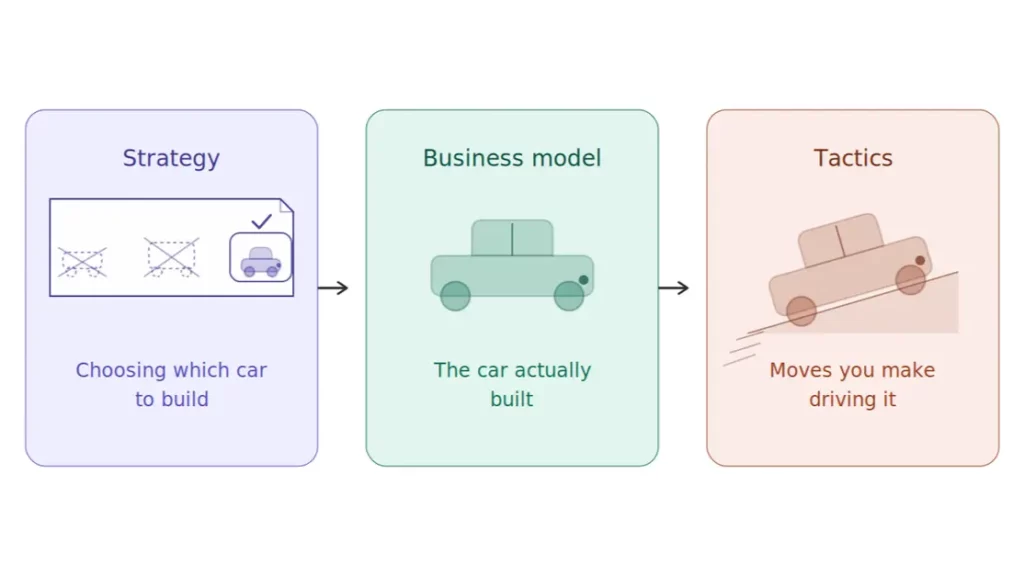
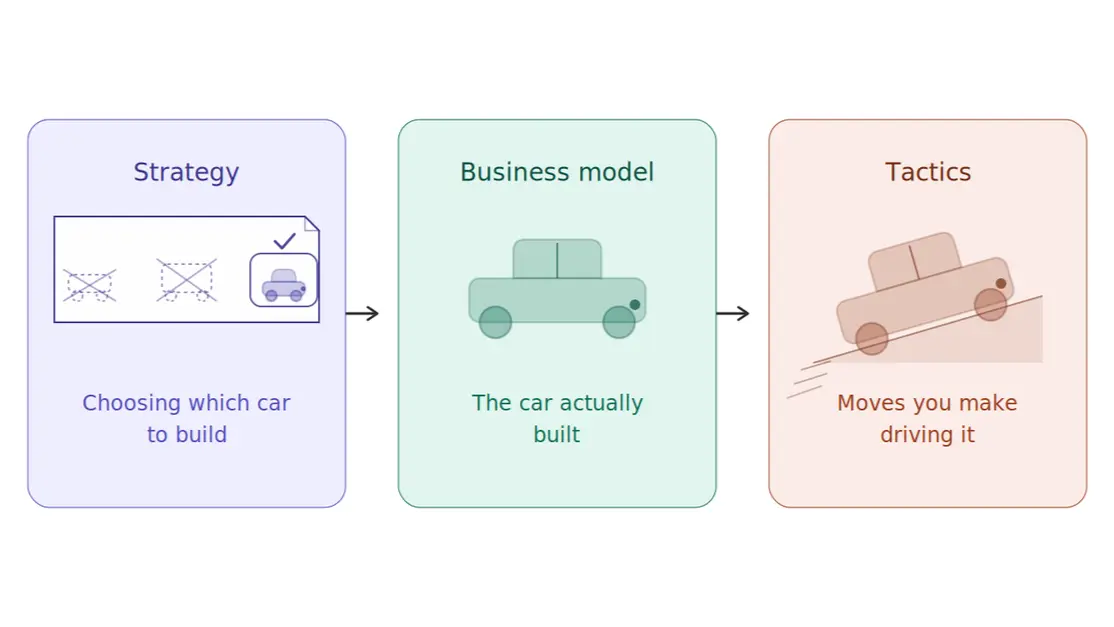
Let me explain, using the same analogy Harvard Business School researchers Ramon Casadesus-Masanell and Joan Ricart use — building and driving a car. It’ll make sense once we get through it, and I’ll simplify it with examples at the end.
Here’s how the paper frames it: every car has its own way of operating. A hybrid runs differently from a conventional engine. A manual drives differently from an automatic. Different cars suit different needs — a small car for congested city streets, a large SUV for open countryside, a standard transmission for control. None of these is the “right” car. Each is built for a different job.
Strategy, business model, and tactics — in one sentence each
Here’s how it explains the terms:
Deciding which of these to build — based on who you’re serving, what job you need the car to do, and how you intend to do that better than others — is Strategy.
The car you actually end up building is the Business Model.
The day-to-day moves you make once that car is in use are Tactics.
Why the difference actually matters
Now here’s the interesting part: the car you build decides what moves you even have available while driving it. A powerful SUV simply can’t thread a narrow city lane the way a small compact can — that move isn’t on the table, no matter how skilled the driver is.
So if your competitor is driving a fundamentally different car, no amount of clever driving (tactics) closes the gap. The only real fix is to build a different car — that’s strategy stepping in to redesign the business model, not tactics trying to compensate for it. And once that model exists, tactics are simply what you do inside it — which is why the same tactical move can win in one business and fail completely in another.
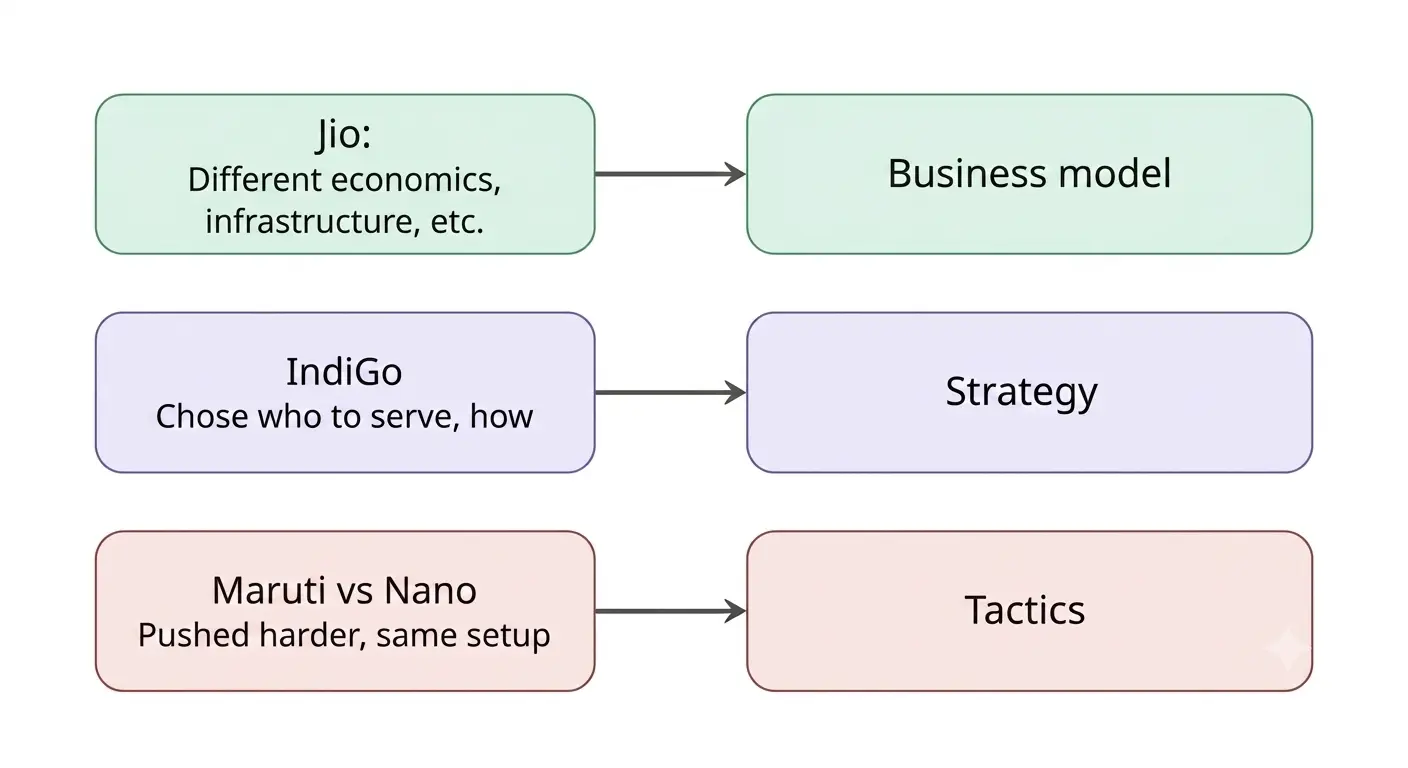
Let’s look at a few interesting moves and work out what they actually are — strategy, business model, or tactics.
Jio: when a competitor is running a different business model
In 2016, Jio entered Indian telecom with free voice calls and dirt-cheap data. Airtel, Vodafone, and Idea responded the way most companies do with tactics: they cut prices, ran counter-offers, launched promotions. None of it worked.
Jio wasn’t simply being more aggressive within the old model — it was operating from a different one altogether. It built an all-IP 4G-only network from scratch, carrying none of the 2G/3G infrastructure costs its rivals were still maintaining, and it was backed by Reliance’s balance sheet rather than telecom revenue alone. The demand logic was different too — Jio priced to build scale first, crossing 100 million subscribers within its first few months.
What looked like a price war was really a business model collision. The incumbents’ responses failed because they were fighting a structurally different machine with the logic of their own — and within two years, their average revenue per user had collapsed, and one of them had exited the market entirely.
IndiGo: when strategy is the entire competitive battle
When IndiGo entered India’s aviation market in the mid-2000s, it wasn’t competing by offering discounts, promotions, or loyalty plans. It wasn’t competing on tactics at all. The rivalry played out at the strategy level.
IndiGo asked who it wanted to serve, what job it needed to do, and how it could do that better than others — and answered with a single value proposition: on-time performance, for people traveling for work who wanted reliability over frills. Every choice it made was built around that one promise: a single aircraft type to keep turnarounds fast and predictable, fewer airports to reduce points of delay, all-economy seating to speed up boarding, and sale-and-leaseback financing to keep expansion fast without debt slowing it down.
Jet Airways and Kingfisher were solving a different problem entirely — wider networks, mixed fleets, premium cabins, aggressive long-haul bets. Nothing in their model was built around reliability the way IndiGo’s was. When the 2008 fuel price spike hit, their machines cracked; IndiGo’s stayed close to break-even, because every part of it had been built to run lean and on time in the first place.
It expanded quickly each time a rival stumbled — after Kingfisher collapsed in 2012, after Jet Airways failed in 2019 — and became India’s largest airline by market share within six years of starting operations.
Maruti vs. Tata Nano: when tactics worked
Maruti already had the Alto — its entry-level workhorse since 2000. When Tata Nano was announced in January 2008 as the world’s cheapest car, aiming to pull first-time buyers away from entry-level hatchbacks, Alto’s volumes briefly dipped. Then production got delayed: the Singur plant ran into land acquisition protests, and Tata had to relocate the entire factory to Sanand, Gujarat, pushing Nano’s actual launch back to 2009.
Maruti’s response wasn’t to build a new car. It was to push harder on the one it already had. It didn’t change anything about how it operated — it still had the Alto, its dealer reach, its service network, and years of brand trust already in place. It simply pushed harder on that existing machine: discounts, financing schemes, and aggressive offers on the Alto, timed to win over buyers before Nano could even arrive.
That’s the signature of tactics: nothing structural changes, you just push harder on the machine you’ve already built.
Bringing it back together
→ Strategy is deciding which business model to run — based on who you’re serving, what job you’re solving, and how you’ll do it better than others.
→ Business model is the actual setup that results — its pricing, cost structure, partnerships, and operations — and what that setup produces.
→ Tactics are the day-to-day moves you make within that setup, without changing it.
The layer you’re operating on decides which moves are even available to you. Which is why the first question worth asking, before reacting to any competitor’s move, isn’t “what should we do” — it’s “what layer is this actually happening at.”
Think of a business move that made you pause recently — name it, and tell me where it fits: strategy, business model, or tactic.
FAQ SECTION
1. What’s the difference between strategy, business model, and tactics?
Strategy is the decision about which business model to build — based on who you serve and how you’ll do the job better than others. Business model is the actual setup that results (pricing, cost structure, operations). Tactics are the day-to-day moves you make inside that setup, without changing it.
2. Why do strategy and tactics get confused so often?
Because both involve “moves” a company makes — but tactics operate inside an existing business model, while strategy is the decision that creates or redesigns the model itself. Confusing the two means treating a structural gap like something a clever tactic can fix.
3. Can tactics beat a competitor with a fundamentally different business model?
No. If a competitor is operating from a different business model, matching their moves tactically won’t close the gap — as seen when Airtel, Vodafone, and Idea cut prices to compete with Jio’s fundamentally different network and cost structure, and it didn’t work.
4. What’s a real example of a business model shift beating incumbents on tactics?
Jio’s 2016 entry into Indian telecom. It built an all-IP 4G-only network with a different cost and demand logic entirely, so incumbents’ price cuts and promotions — pure tactics — couldn’t respond to what was actually a business model collision.
5. What’s an example of strategy alone deciding a competitive outcome?
IndiGo’s entry into Indian aviation in the mid-2000s. It picked a single value proposition — on-time performance for work travelers — and built every operational choice around it, which let it stay near break-even in the 2008 fuel spike while rivals with broader, mixed strategies struggled.
6. When is doubling down on tactics actually the right move?
When your existing business model is still sound and a competitor’s threat hasn’t changed the game structurally — like Maruti pushing discounts and financing on the Alto against the delayed Tata Nano, without changing its underlying setup.
7. How can a leader tell which “layer” — strategy, business model, or tactics — a competitive situation is happening at?
Ask whether the issue is about who you’re serving and how (strategy), the actual structural setup producing results (business model), or a day-to-day move within an unchanged setup (tactics). The right response depends entirely on identifying the correct layer first.

Priyanka Sahay is a Leadership Faculty at GlobalGyan Leadership Academy with experience across corporate leadership, entrepreneurship, and organisational development. She holds an MBA in International Business and is a qualified lawyer and psychologist. Her corporate experience, followed by building and managing her own venture, has given her a practical understanding of strategy, operations, people, and business decision-making. She works with middle and senior-level managers to develop strategic thinking, business acumen, and leadership effectiveness. Her multidisciplinary background brings together commercial, legal, and behavioural perspectives to help leaders make better decisions and navigate complex organisational challenges.
View LinkedIn Profile



 GlobalGyan Leadership Academy
Responses