
Why Do Leaders Struggle to Stay on Top of Their Work?



Gargi, a mid-level manager in a multinational corporation, was known for her dedication and hard work. She prided herself on being reliable, but lately, she felt like she was drowning in work. Her inbox was overflowing with emails, her team members were constantly seeking her approval on projects, and her calendar was packed with back-to-back meetings.
On a typical Monday morning, Gargi walked into the office determined to tackle her priority tasks for the day. However, before she could even open her laptop, she was pulled into an urgent discussion with her boss. By noon, she had handled multiple last-minute requests, approved three proposals, and responded to several emails, but her own high-priority tasks remained untouched. By the end of the day, she felt exhausted yet unaccomplished.
Gargi’s story is not unique. According to a study by McKinsey, employees spend up to 60% of their workweek on unproductive tasks such as email, meetings, and administrative work, leaving little time for high-impact strategic work. The real challenge?
Many professionals are constantly busy but not necessarily productive.
That’s when Gargi discovered David Allen’s Getting Things Done (GTD) methodology, a structured approach designed to help professionals take control of their work instead of letting their work control them. The transition was not easy, but once she implemented GTD, her workday became more structured, her stress levels dropped, and she finally felt in control.
Let’s explore how this methodology can help professionals like Gargi bring clarity and efficiency to their work.
What is the GTD Methodology?
David Allen, a productivity consultant, developed the Getting Things Done (GTD) system based on a simple yet powerful principle: Your mind is for having ideas, not holding them. The human brain is great at generating thoughts but inefficient at storing and organizing them. The GTD method provides a structured way to capture, clarify, and execute tasks without feeling overwhelmed.
The GTD system consists of five core steps:
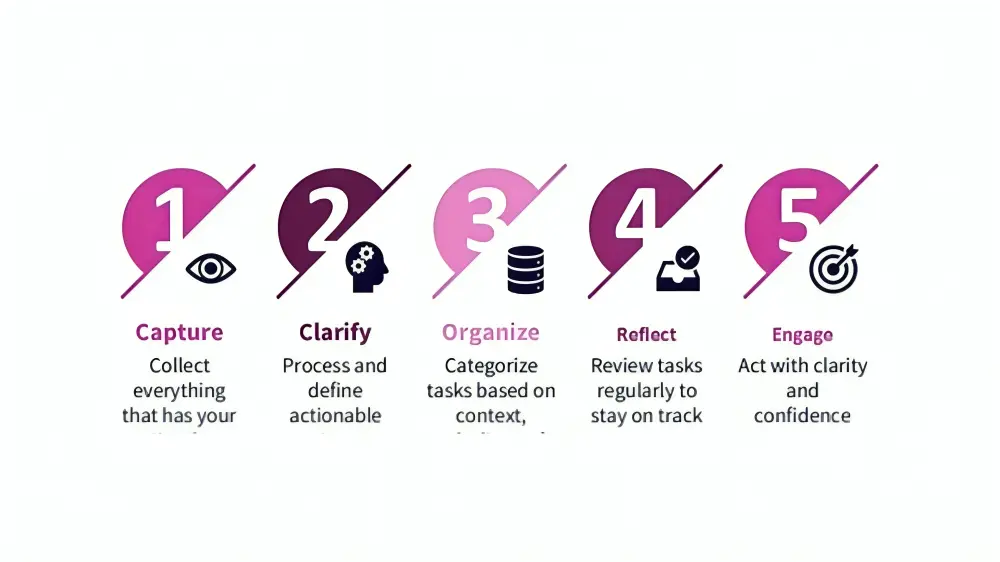
Applying GTD in a Corporate Role: How Gargi Turned Things Around
Step 1: Capture Everything That Demands Attention
Instead of relying on mental notes, Gargi started recording everything—emails, meeting action items, project deadlines, and even personal reminders—in a structured system.
Individuals who create written daily to-do lists are, on average, 25% more productive, according to a study by Time Management experts.
Step 2: Clarify and Define the Next Action
Gargi realized that not all tasks required immediate action. Some could be delegated, postponed, or categorized as reference material.
She asked herself: Is this actionable?
- If YES → She defined the next step (e.g., “Prepare Q3 financial summary” instead of just “Financial summary”).
- If NO → She deleted it, stored it for later, or moved it to a reference list.
Step 3: Organize Based on Priorities
Instead of working on tasks as they appeared, Gargi started categorizing them based on priority and urgency.
- Calendar – Scheduled time-sensitive tasks.
- Next Actions – Immediate to-dos.
- Waiting For – Tasks she delegated and was waiting for updates on.
- Someday/Maybe – Ideas for future projects.
This approach not only improved her efficiency but also reduced mental clutter. Research supports the idea that organization plays a crucial role in productivity. A Princeton University study found that the presence of “task-irrelevant objects” can make it significantly harder to focus. While this study highlights the impact of physical clutter, the same principle applies to mental clutter caused by an unstructured task list. By prioritizing tasks and maintaining clarity, Gargi was able to reduce stress and enhance her productivity.
Step 4: Reflect and Review Progress
Each Friday, Gargi dedicated 30 minutes to a weekly review where she reassessed priorities and adjusted plans accordingly.
She asked herself:
- What are the top priorities for next week?
- Are there pending approvals or follow-ups?
- Can I delegate or automate anything?
GE follows a similar approach by replacing annual reviews with continuous feedback, ensuring agility and alignment with evolving goals.
Step 5: Engage and Execute
With a structured system, execution became straightforward. Gargi no longer started her day feeling lost—she had a clear, prioritized list to work through.
She adopted the 2-minute rule—if something took less than two minutes (like responding to an email), she did it immediately.
Research by the American Psychological Association (APA) shows that completing small tasks immediately reduces mental load and improves productivity by 25% over time.
The Challenges Gargi Faced While Implementing GTD
While GTD was transformational, it wasn’t without its challenges:
- Consistency – It took discipline to maintain and review her lists regularly.
- Over-categorization – Initially, she spent too much time organizing instead of executing.
- Company culture – Her team wasn’t used to such structured task management, so she had to introduce GTD gradually.
Over time, she learned that GTD is not a rigid system but a flexible framework—and adapting it to her workflow made all the difference.
Taking Corporate Productivity to the Next Level
Gargi’s journey from chaos to clarity proves that Getting Things Done isn’t just about organizing tasks—it’s about taking control of your professional life. Whether you’re a corporate leader, a manager, or an ambitious professional, GTD can help you work smarter, not harder.
According to a Deloitte survey, companies that promote structured productivity systems report higher employee engagement and a 15% reduction in burnout.
Start small. Capture your tasks today, organize your list, and experience the shift in how you manage your workload. Your future self, and your career, will thank you.
So, what’s one professional task you’ve been putting off? How about applying GTD and finally getting it done?
FAQ SECTION
1. What is the GTD (Getting Things Done) methodology?
A productivity system developed by David Allen, based on the idea that the mind is for having ideas, not storing them. It provides a structured way to capture, clarify, and execute tasks so nothing gets lost or causes mental overload.
2. What are the five steps of the GTD method?
Capture everything demanding attention, clarify whether it’s actionable and define the next step, organize tasks by priority, reflect through regular review, and engage by executing with a clear, prioritized list.
3. Why do leaders feel busy all day but unproductive?
Because time often goes to reactive, low-impact work like emails, meetings, and last-minute requests rather than high-priority strategic tasks — a pattern seen in the article’s example of a manager overwhelmed despite working hard all day.
4. What is the 2-minute rule in the GTD method?
If a task takes less than two minutes — like replying to a short email — do it immediately instead of adding it to a list, which reduces mental clutter and the buildup of small pending tasks.
5. What’s the purpose of a weekly review in GTD?
To step back, reassess priorities, check on pending approvals or follow-ups, and adjust plans — keeping the system aligned with what actually matters instead of just staying busy.
6. What common challenges come with adopting GTD?
Maintaining consistency in reviewing lists, avoiding the trap of over-categorizing instead of executing, and introducing the system gradually if a team culture isn’t used to structured task management.

Sourabh is a former Learning Solutions Manager at GlobalGyan Leadership Academy and a learning and organisation development professional with experience across management education, consulting, energy, and lifestyle sectors. He has worked with LeaderSource Consulting, Ekā Life, and Hindustan Petroleum, where he began his career in capability development. A postgraduate in Human Resource Development from the Jamnalal Bajaj Institute of Management Studies (JBIMS) and a certified POSH trainer, Sourabh is also a national-level award-winning public speaker. He brings deep expertise in learning design, capability building, facilitation, and organisational development.
View LinkedIn Profile




 GlobalGyan Leadership Academy
Responses